Enabling the AI Era with High-Density, Low-Loss MPO Cabling Solutions for Data Centers
Introduction
As we rapidly enter the age of artificial intelligence (AI), the demand for high-speed, high-capacity data transmission has grown exponentially. Modern AI applications, particularly those involving machine learning and large-scale data analytics, require immense computational power and vast volumes of data transfer between servers, storage, and compute clusters. In this scenario, traditional cabling infrastructures often fall short of meeting the performance, scalability, and density requirements of next-generation data centers.
One of the most effective solutions that have emerged is the deployment of high-density, low-loss MPO (Multi-fiber Push-On) cabling systems. MPO connectors, including their advanced variant MTP®, provide a scalable, efficient, and cost-effective means to handle high-bandwidth applications in data centers, thereby powering the AI revolution.
The Evolution of Data Center Cabling
Traditional data center cabling solutions—based on duplex LC connectors—were sufficient during the early 10G/25G/40G Ethernet days. However, with the advent of 100G, 200G, and 400G networks, and now even 800G and 1.6T architectures on the horizon, the limitations of duplex cabling have become apparent. These systems are difficult to manage at scale, consume excessive rack space, and are less efficient in high-density environments.
MPO cabling systems were designed to overcome these constraints. By enabling parallel transmission over multiple fibers, MPO connectors can support 8, 12, 16, 24, or even 32 fibers within a single compact interface. This compact, high-density solution not only saves space but also improves the performance and scalability of modern data centers.
Why MPO Cabling is Ideal for AI Infrastructure
1. High-Density Design
AI training and inference platforms, such as those using GPU clusters or custom AI accelerators, require densely packed hardware interconnected through high-speed links. MPO cabling allows for a higher number of fiber connections in a smaller footprint, enabling more connections per rack unit. This helps maximize space utilization—an essential factor in large-scale AI data centers.
2. Low Insertion Loss
AI workloads are highly sensitive to latency and transmission errors. To ensure efficient and reliable data transmission, the use of ultra-low-loss MPO connectors is critical. These high-performance connectors minimize signal degradation, which is particularly important when signals travel through multiple interconnects or over longer distances.
3. Ease of Scalability
AI projects often start small and scale rapidly. MPO cabling systems are inherently modular, allowing for quick expansions or upgrades without major overhauls. With pre-terminated and tested MPO cables, installation is plug-and-play, reducing deployment time and operational disruptions.
4. Support for Parallel Optics
AI data center interconnects increasingly rely on parallel optics technologies to achieve speeds beyond 100G. MPO connectors are the standard interface for these systems, as they allow simultaneous transmission and reception across multiple fibers. This is essential for 400G and 800G networks, where breakout configurations like 8x50G or 8x100G are used.
Components of an MPO-Based Cabling System
A high-performance MPO cabling infrastructure includes several key components:
1. MPO/MTP® Trunk Cables
These are high-fiber-count backbone cables pre-terminated with MPO connectors. They form the main distribution link between switches, servers, and patch panels. Trunk cables are typically available in 12, 24, 48, or 72 fiber counts.
2. MPO Cassettes and Modules
MPO cassettes are used to convert MPO connectors into standard duplex LC or SC connectors. This is useful when interfacing with equipment that still relies on duplex ports, allowing seamless integration within hybrid environments.
3. Patch Panels and Adapter Plates
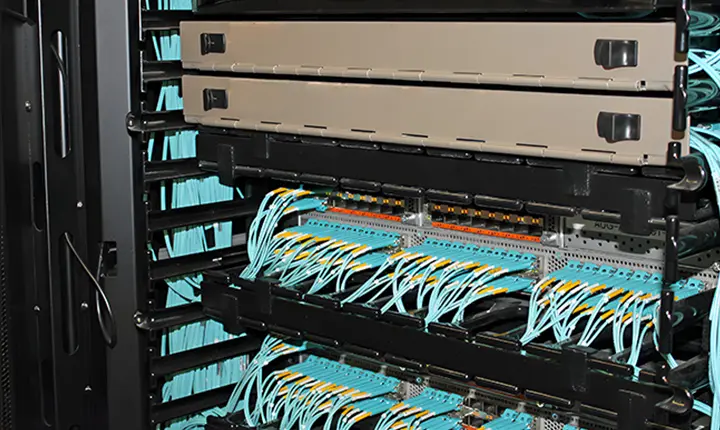
Patch panels provide the structured cabling interface and house the MPO adapters or cassettes. High-density panels can support hundreds of fibers within a 1U or 2U rack space, streamlining cable management.
4. MPO Patch Cords
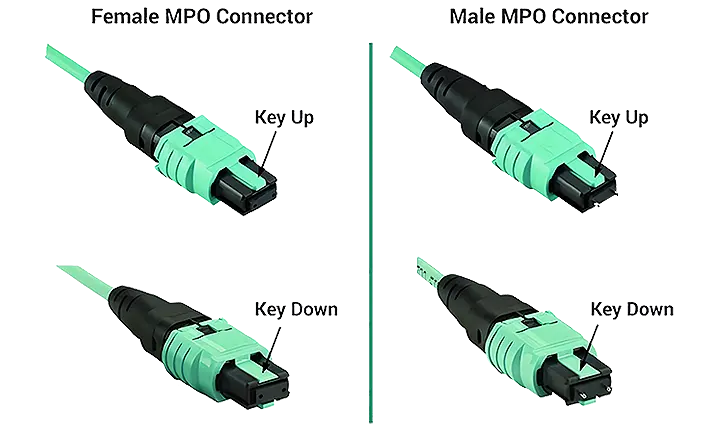
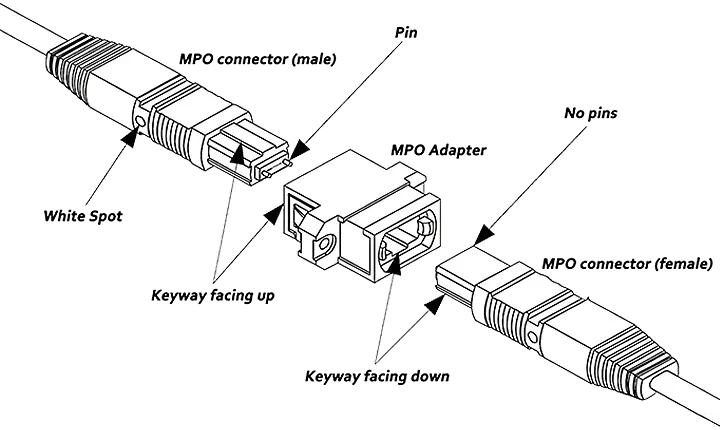
Used to connect trunk cables or link active equipment to cassettes or panels, these cords are available in various configurations: straight-through, key-up/key-down, and polarity-corrected for specific network designs.
5. Polarity Management
MPO systems require careful polarity planning to ensure correct signal path alignment. Common methods include Method A (straight), Method B (crossover), and Method C (pairwise flip). Selecting and maintaining the correct polarity is crucial for system reliability.
Use Cases of MPO in AI-Powered Data Centers
1. High-Performance Computing (HPC) Clusters
AI training workloads often run on HPC clusters using NVIDIA DGX systems, AMD EPYC platforms, or custom ASICs like Google TPUs. These environments demand ultra-high-speed interconnects, typically leveraging InfiniBand or 400G/800G Ethernet. MPO cabling is used extensively here to link compute nodes, storage, and switches.
2. AI-Driven Cloud Services
Major cloud providers like AWS, Microsoft Azure, and Google Cloud use MPO-based infrastructure in their hyperscale data centers to interconnect thousands of servers handling AI services like image recognition, natural language processing, and recommendation engines.
3. Edge AI Data Centers
In edge environments where space is constrained, MPO’s high-density nature makes it ideal. AI applications at the edge—such as video analytics or autonomous vehicle data processing—require high-throughput and low-latency communication between compact, high-performance nodes.
4. AI Model Inference Farms
Once AI models are trained, they are deployed in inference servers that respond to real-time queries. These servers rely on dense interconnectivity, often through leaf-spine network topologies facilitated by MPO cabling, to manage massive request volumes.
MPO Deployment Best Practices
To ensure optimal performance, the following best practices should be adopted:
1. Pre-Terminated Solutions
Using factory-terminated MPO cables improves quality, consistency, and installation speed. Pre-terminated links come fully tested with test reports, reducing the need for onsite termination and testing.
2. End-Face Cleanliness
Even a microscopic dust particle on an MPO connector can cause loss or reflection. It is crucial to clean and inspect connectors using appropriate tools before mating.
3. Polarity Planning and Documentation
Improper polarity can cause costly delays and errors. Clear documentation of the polarity scheme, along with color-coded cables or labels, helps avoid confusion during installation and future maintenance.
4. Cable Management and Bend Radius
Due to the larger cable diameter of MPO trunk cables, careful routing and bend-radius compliance are essential. Using cable trays, raceways, and fiber guides can prevent signal degradation and prolong cable lifespan.
5. Testing and Certification
MPO links should be tested using Tier 1 (loss and length) and Tier 2 (OTDR) testing where appropriate. Ensure MPO testers support multi-fiber interfaces and have appropriate reference methods in place.
The Role of MPO in 400G and Beyond
With the deployment of 400G and 800G networks, MPO cabling is no longer optional—it’s essential. These high-speed standards utilize either parallel optics or wavelength division multiplexing (WDM), both of which benefit from MPO’s capacity.
For instance, 400GBASE-SR8 uses eight parallel fibers at 50Gbps each. A 16-fiber MPO connector (8 transmit, 8 receive) is required. Similarly, 800G deployments using PAM4 modulation often leverage 2x400G links, necessitating even higher fiber counts and more careful cabling design.
MPO’s ability to handle these configurations with minimal insertion loss and maximum density positions it as a future-ready solution for data centers aiming to support the next era of networking.
Economic and Environmental Benefits
High-density MPO solutions not only boost performance but also offer economic and environmental benefits:
Lower CapEx and OpEx: Faster deployment, easier upgrades, and reduced space requirements translate to cost savings.
Energy Efficiency: Lower signal loss and efficient routing minimize power consumption.
Reduced Downtime: Modular, plug-and-play systems reduce human error and maintenance times.
Conclusion
The dawn of the AI era places unprecedented demands on data center infrastructure. High-density, low-loss MPO cabling provides a robust, scalable, and efficient foundation to meet these challenges head-on. Whether you’re building hyperscale AI clusters or managing distributed inference workloads, MPO technology ensures your network backbone is capable of keeping pace with the speed of innovation.
In summary, the MPO cabling solution is not just an enhancement—it’s an enabler. By adopting structured MPO-based infrastructure, data centers can unlock higher performance, better scalability, and more reliable operations, effectively powering the intelligent systems of tomorrow.




 No products in the cart.