

MTP 16 Jumper
MTP® jumpers enable smooth upgrades to higher bandwidth in data centers when paired with our trunk assemblies. Commonly deployed for cabinet-level interconnections, MTP® cables offer a more economical solution than labor-intensive on-site terminations. Designed to support high-density fiber installations, they help maximize space utilization and simplify cable organization.
MTP®-16 connectors are well-suited for 16-fiber multimode parallel optics, including 400G QSFP-DD SR8 module connections.
Note: US Conec MTP® connectors comply fully with MPO interface standards and feature patented innovations, improved mechanical accuracy, tested durability, and superior optical performance over standard MPO connectors.
MTP 16 Jumper Advantage Specifications
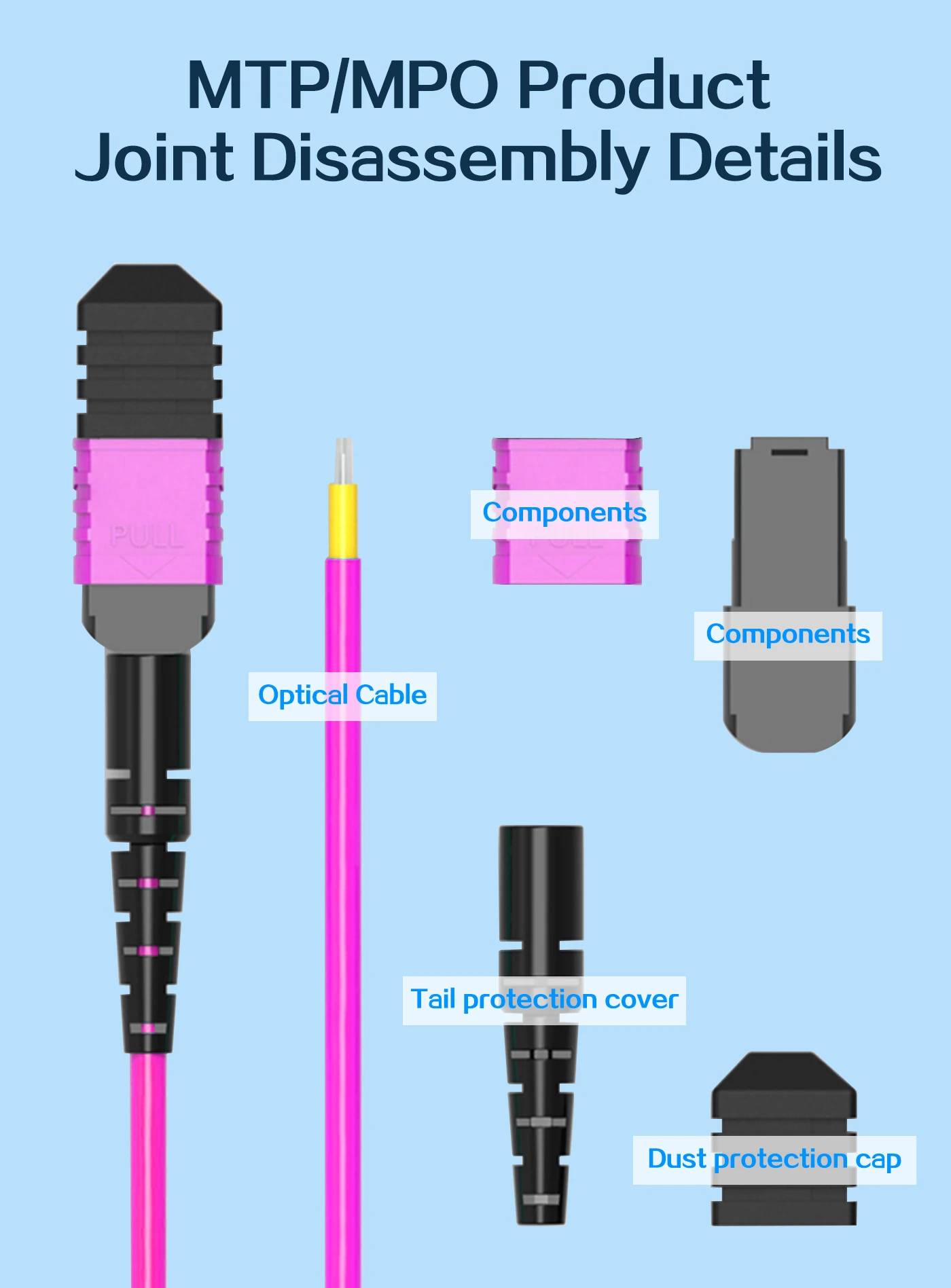
Connector A:US Conec MTP®-16 Male (with guide pins) with Offset Key
Connector B:US Conec MTP®-16 Male (with guide pins) with Offset Key
Polish Type:APC to APC
Fiber Mode:OM4 50/125μm
Wavelength:850/1300nm
Fiber Count:16 Fibers
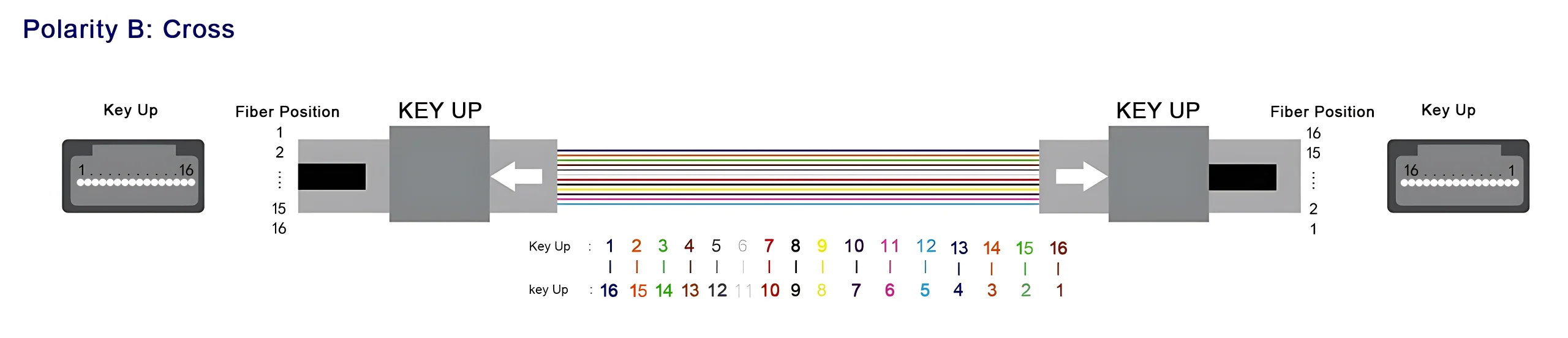
Polarity:Type B
Cable Outside Diameter (OD):3.0mm
Cable Jacket:Plenum (OFNP)
Min. Bend Radius (Optical Fiber):7.5mm
Min. Bend Radius (Fiber Cable):20/10D (Dynamic/Static)
Connector Durability:500 times
Tensile Strength:80/240N (Long/Short Term)
Insertion Loss:0.35dB Max
Return Loss:≥27dB
Attenuation at 850nm:≤2.3dB/km
Attenuation at 1300nm:≤0.6dB/km
Operating Temperature:-10 to 60°C (14 to 140℉)
Storage Temperature:-10 to 70°C (14 to 158℉)
*MTP is a registered trademark of US Conec Ltd.
MTP Jumper Cable Polarity
The MTP® 16-fiber Type B male connector is a high-density optical interconnect solution optimized for parallel optics in advanced data centers. Type B polarity follows a reversed (flipped) mapping, which means the fiber positions at one end of the connector are mirrored at the opposite end. For example: Fiber 1 → Fiber 16, Fiber 2 → Fiber 15, Fiber 3 → Fiber 14 … Fiber 16 → Fiber 1. This ensures that transmit (Tx) fibers on one device connect directly to receive (Rx) fibers on the opposite device, which is essential for parallel transmission protocols.
As a male connector, it is equipped with two alignment pins on the ferrule, ensuring precise core-to-core alignment when mated with female connectors. This guarantees stable optical performance with low insertion loss.
MTP Jumper Cable Key Features:
Connector type: MTP® 16-fiber male (with guide pins)
Fiber count: 16 fibers in a single-row high-density ferrule
Polarity standard: Type B (reversed mapping, flipped orientation)
Cable jacket options: OFNR, OFNP, or LSZH, with standard color codes (yellow for OS2, aqua/violet for OM3/OM4, lime green for OM5)
Enhanced design: MTP® technology improves return loss, minimizes insertion loss, and ensures robust durability compared to generic MPO connectors
MTP Jumper Cable Applications:
High-speed parallel optics: Supports 200GBASE-DR4, 400GBASE-SR16, 400GBASE-DR4, and emerging high-bandwidth Ethernet standards
Direct transceiver connections: Commonly used for 16-fiber transceivers, where reversed polarity is necessary for correct Tx/Rx alignment
Data center backbone cabling: Enables structured cabling systems with modular trunks and cassettes
Scalable architectures: Designed for migration paths from 100G to 200G and 400G networks
MTP Jumper Cable Advantages:
Correct Tx/Rx alignment: Reversed polarity ensures that transmit channels always connect to receive channels
High-density efficiency: 16 fibers in one compact connector reduce cable bulk in racks and conduits
Reliable mating: Male guide pins guarantee secure and accurate alignment with female connectors
Future-ready scalability: Supports next-generation Ethernet standards and evolving high-speed optical technologies
MTP 16 Jumper Advantage
- 100% use low-loss connectors
- Each MPO patch cord is fully tested for insertion loss & return loss, 100% tested, and batch goods are not sloppy
- Each line guarantees 3D geometric dimensions and end face integrity, imported equipment measures 3D, and dust-free workshops ensure cleanliness
- Affordable price, quality assurance, source manufacturers take both quality and price into consideration
- All materials have passed REACH/ROHS environmental protection requirements and are of export quality
- Adequate inventory, complete materials, and efficient production
- Customization of special specification MPO patch cords, fast delivery
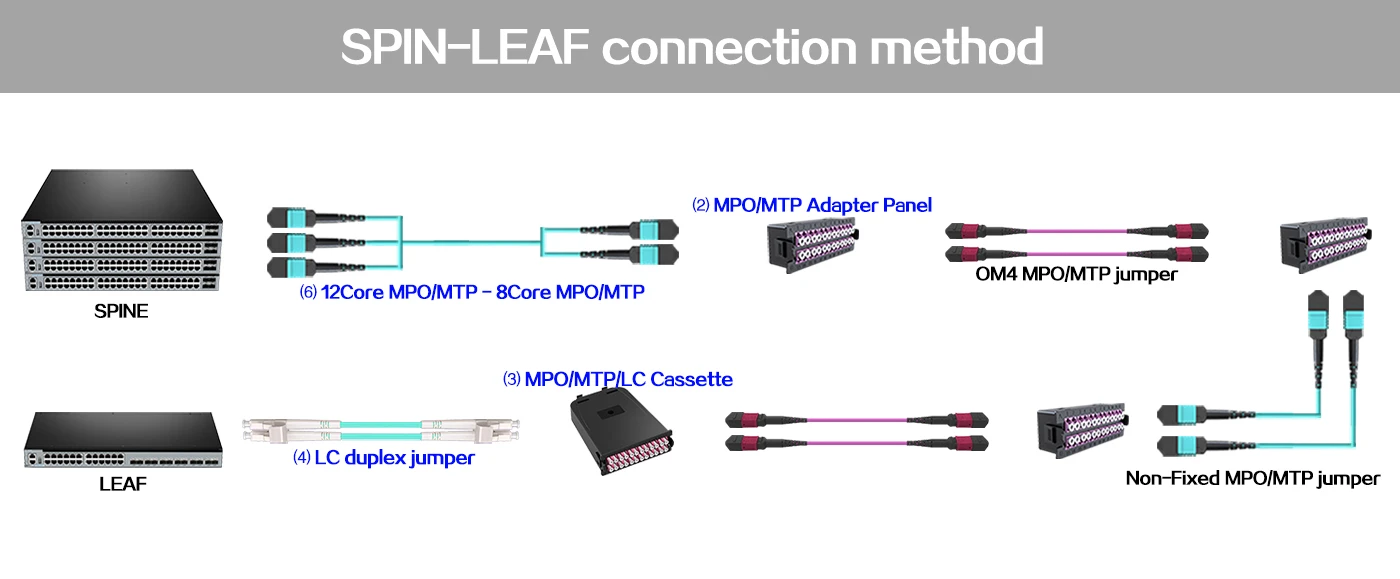
MTP 16 Jumper SPIN-LEAF connection method
MTP 16 Jumper Application
High-speed interconnection in data centers
It is used for direct connection of 40G/100G optical modules, supports 400G high-speed transmission, and can improve wiring density and transmission efficiency. For example, 400G QSFP-DD DR4 optical modules can be directly connected through MPO/MTP-8 multimode fiber jumpers.
High-density wiring scenarios
In the backbone wiring of data centers, MTP/MPO trunk fiber jumpers are used in conjunction with adapter modules to achieve interconnection and cross-connection between devices, saving 45% of wiring space. Branch jumpers are used to connect devices with different rates (such as 10G and 40/100G devices).
100G/400G transmission expansion
Supports branch connection of 100G QSFP28 optical modules to 4 25G SFP28 optical modules, or interconnection of 100G CFP optical modules to another CFP.
Fiber-to-Building Applications
It is used for fiber-to-the-building (FTTB) wiring to meet the needs of high-density fiber access.

MTP 16 Jumper Test Series
MTP 16 Jumper Polarity Test Process
End face cleaning: Use special equipment to remove end face contaminants to avoid affecting the test accuracy.
Morphology detection: Analyze the end face microstructure through 3D imaging technology to detect surface roughness, scratches and other defects.
Insertion loss test: Measure the contact loss between the fiber end face and the connector ferrule to evaluate the signal transmission quality.
Polarity verification: Confirm the correspondence between the number of fiber cores and the connector guide hole to prevent communication failure caused by wrong connection.
MTP 16 Jumper Test Key Indicators
Cleaning efficiency: It must reach more than 98% to ensure that there are no residual stains on the end face.
Detection accuracy: The resolution of 3D morphology detection must be less than 1.5μ, and the insertion loss error must be controlled within 0.3dB.
Test time: It takes about 10 seconds to detect a single fiber core of a 12-core MPO jumper, and the overall test takes about 2 minutes.
MTP 16 Jumper cable Test Common Problems
Pollution sensitivity: Tiny particles on the end face will cause increased loss, and non-contact cleaning methods are required to protect the end face.


 No products in the cart.
Reviews
There are no reviews yet.