

MTP Fiber Cables
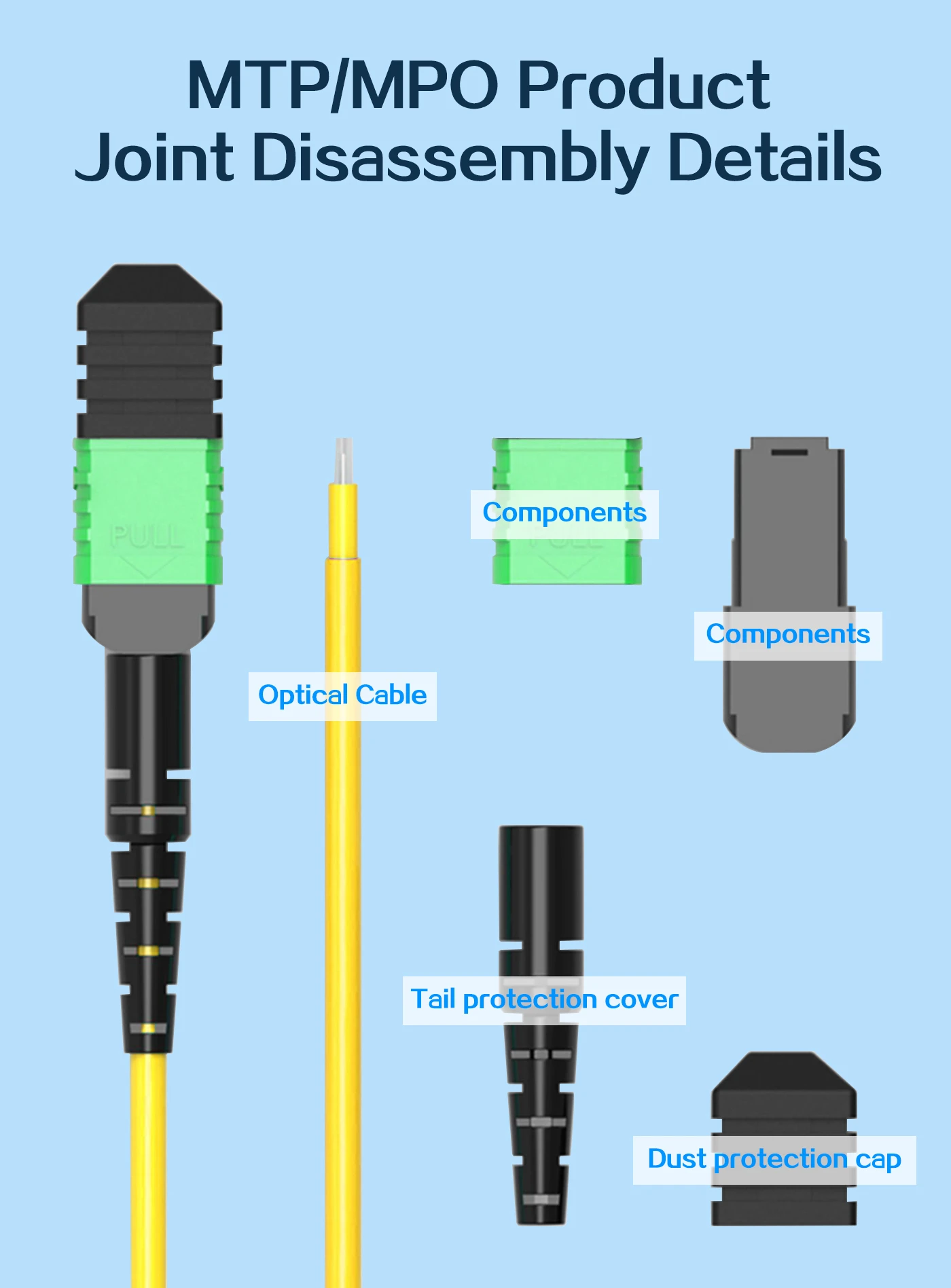
MTP® jumpers enable smooth upgrades to higher data rates in data centers when paired with our trunk assemblies. They are commonly utilized for interconnections within racks. MTP® cable provides a cost-efficient substitute to labor-intensive on-site termination and is built for compact, high-density fiber connectivity in environments requiring space efficiency and simplified cable routing.
MTP®-16 is perfectly suited for 16-fiber parallel single-mode transceiver solutions, including 800G QSFP-DD/OSFP DR8 and 800G OSFP XDR8 module links.
Note: US Conec’s MTP® connectors fully adhere to MPO standards, featuring patented innovations, improved alignment precision, verified dependability, and enhanced performance over standard MPO types.
MTP Fiber Cables Advantage Specifications
Connector A:US Conec MTP®-16 Female (Pinless) with Offset Key
Connector B:US Conec MTP®-16 Female (Pinless) with Offset Key
Polish Type:APC to APC
Fiber Mode:OS2 9/125μm(G657A1)
Wavelength:1310/1550nm
Fiber Count:16 Fibers
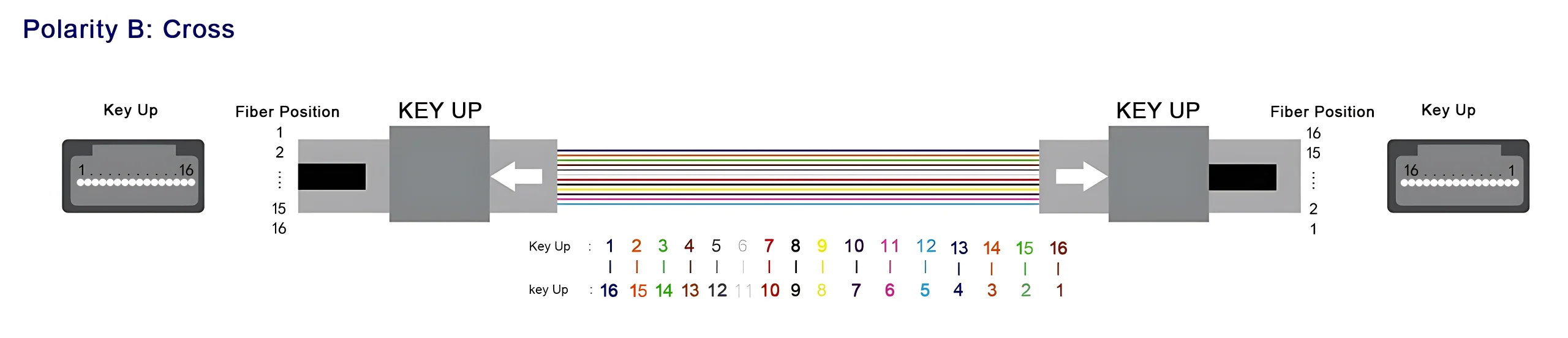
Polarity:Type B
Cable Outside Diameter (OD):3.0mm
Cable Jacket:Plenum (OFNP)
Min. Bend Radius (Optical Fiber):10mm
Min. Bend Radius (Fiber Cable):10/5D (Dynamic/Static)
Connector Durability:500 times
Tensile Strength:80/240N (Long/Short Term)
Insertion Loss:0.35dB Max
Return Loss:≥60dB
Attenuation at 1310nm:≤0.35dB/km
Attenuation at 1550nm:≤0.21dB/km
Operating Temperature:-10 to 60°C (14 to 140℉)
Storage Temperature:-10 to 70°C (14 to 158℉)
*MTP is a registered trademark of US Conec Ltd.
MTP Jumper Cable Polarity
MTP-16F Type B is a high-performance fiber optic connector designed for high-speed parallel transmission, especially for 400G and 800G single-mode transceiver applications (e.g., QSFP-DD DR8, OSFP DR8/XDR8). It uses 16 fibers arranged in a single row and follows a reversed (flipped) polarity to align transmit (Tx) and receive (Rx) channels correctly.
MTP Jumper Cable Key Features:
Connector Type:MTP® (US Conec high-precision MPO variant)
Fiber Count:16 fibers in a single row (often single-mode or multimode)
Polarity Type:Type B (flipped)
Connector Orientation:Key-up to key-up
Application:400G/800G DR8, SR8, XDR8 optical modules
MTP Fiber Cables Advantage
- 100% use low-loss connectors
- Each MPO patch cord is fully tested for insertion loss & return loss, 100% tested, and batch goods are not sloppy
- Each line guarantees 3D geometric dimensions and end face integrity, imported equipment measures 3D, and dust-free workshops ensure cleanliness
- Affordable price, quality assurance, source manufacturers take both quality and price into consideration
- All materials have passed REACH/ROHS environmental protection requirements and are of export quality
- Adequate inventory, complete materials, and efficient production
- Customization of special specification MPO patch cords, fast delivery
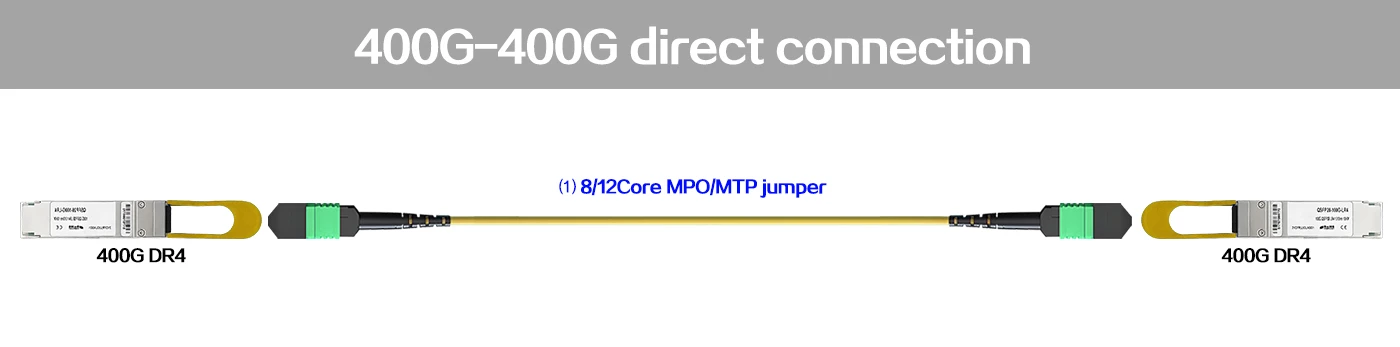
MTP Fiber Cables 400G-400G direct connection mode
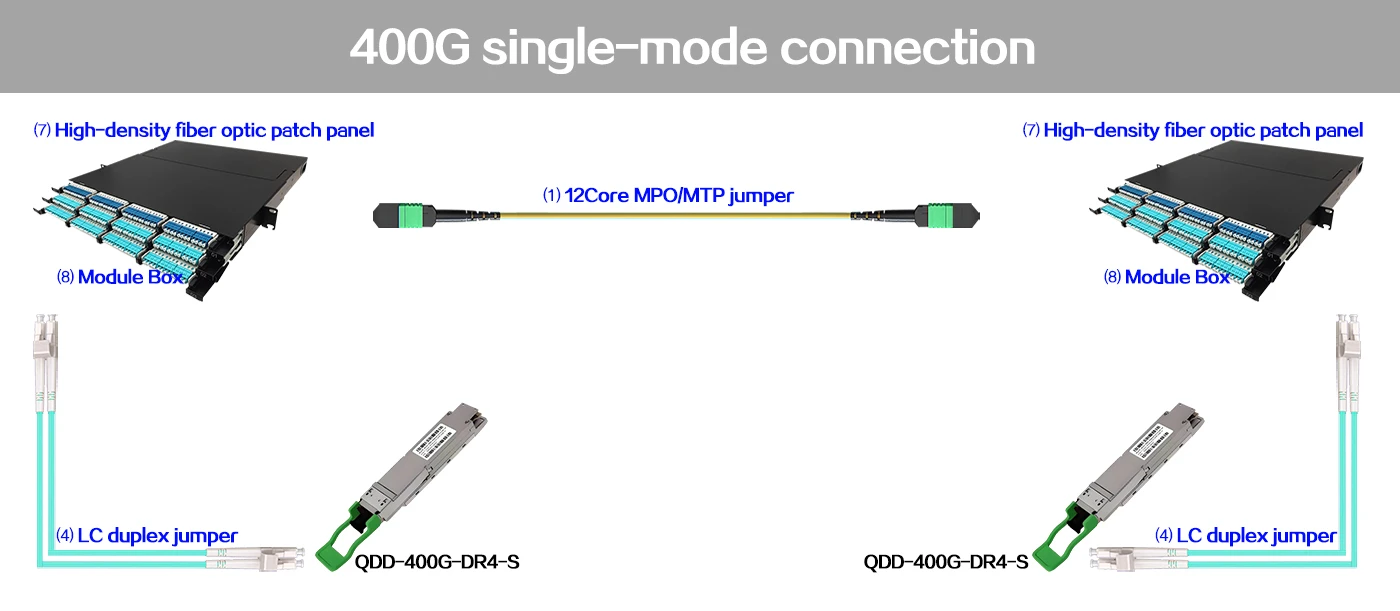
When the 400G QSFP-DD DR4 optical modules at both ends of the machine room can be connected through MPO/MTP-8 single-mode fiber jumpers to achieve 400G transmission.
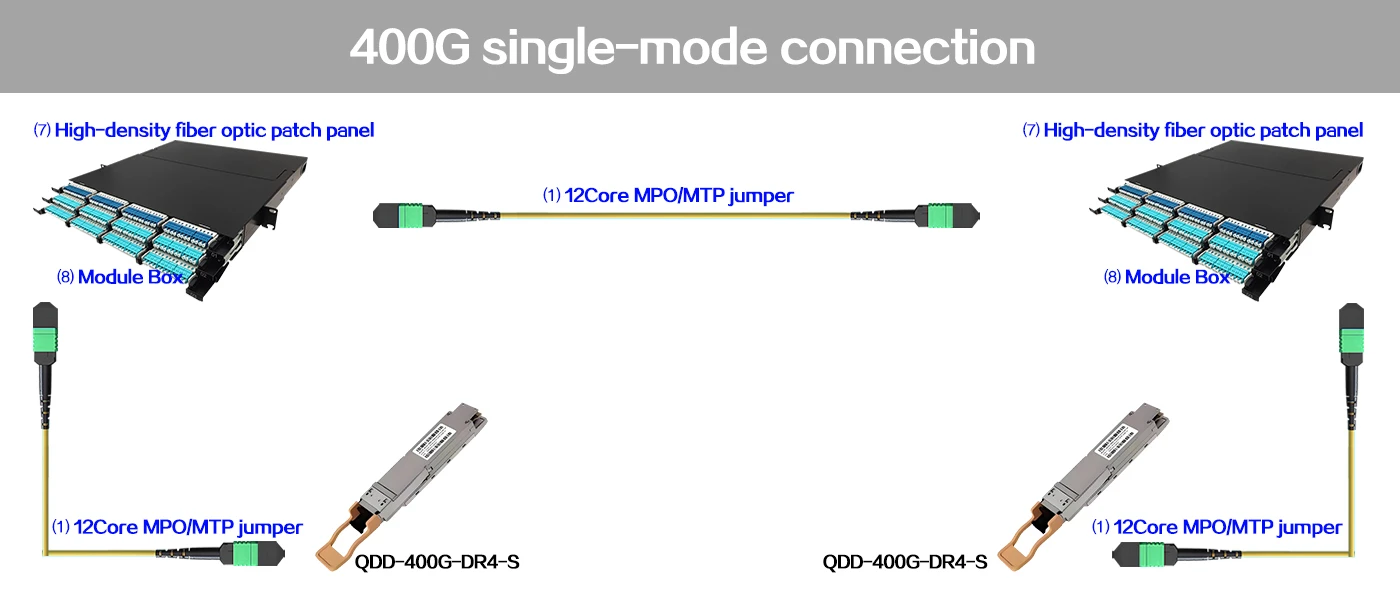
MTP Fiber Cables single-mode connection
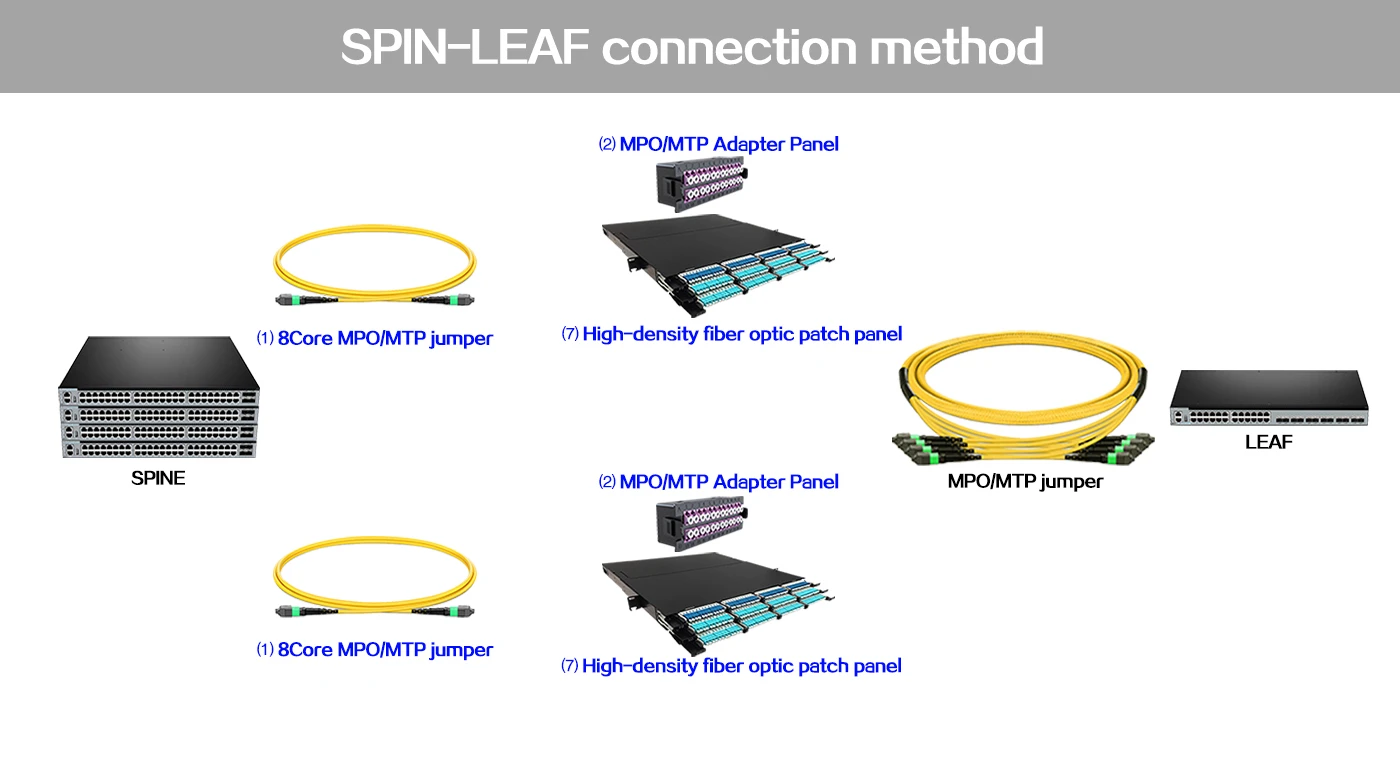
MTP jumper cable SPIN-LEAF connection method
MTP Fiber Cables Application
High-speed interconnection in data centers
It is used for direct connection of 40G/100G optical modules, supports 400G high-speed transmission, and can improve wiring density and transmission efficiency. For example, 400G QSFP-DD DR4 optical modules can be directly connected through MPO/MTP-8 single-mode fiber jumpers.
High-density wiring scenarios
In the backbone wiring of data centers, MTP/MPO trunk fiber jumpers are used in conjunction with adapter modules to achieve interconnection and cross-connection between devices, saving 45% of wiring space. Branch jumpers are used to connect devices with different rates (such as 10G and 40/100G devices).
100G/400G transmission expansion
Supports branch connection of 100G QSFP28 optical modules to 4 25G SFP28 optical modules, or interconnection of 100G CFP optical modules to another CFP.
Fiber-to-Building Applications
It is used for fiber-to-the-building (FTTB) wiring to meet the needs of high-density fiber access.

MTP Fiber Cables Test Series
MTP Fiber Cables Polarity Test Process
End face cleaning: Use special equipment to remove end face contaminants to avoid affecting the test accuracy.
Morphology detection: Analyze the end face microstructure through 3D imaging technology to detect surface roughness, scratches and other defects.
Insertion loss test: Measure the contact loss between the fiber end face and the connector ferrule to evaluate the signal transmission quality.
Polarity verification: Confirm the correspondence between the number of fiber cores and the connector guide hole to prevent communication failure caused by wrong connection.
MTP Fiber Cables Test Key Indicators
Cleaning efficiency: It must reach more than 98% to ensure that there are no residual stains on the end face.
Detection accuracy: The resolution of 3D morphology detection must be less than 1.5μ, and the insertion loss error must be controlled within 0.3dB.
Test time: It takes about 10 seconds to detect a single fiber core of a 12-core MPO jumper, and the overall test takes about 2 minutes.
MTP Fiber Cables Test Common Problems
Pollution sensitivity: Tiny particles on the end face will cause increased loss, and non-contact cleaning methods are required to protect the end face.


 No products in the cart.
Reviews
There are no reviews yet.