

Fiber Adapter (Coupler) Types
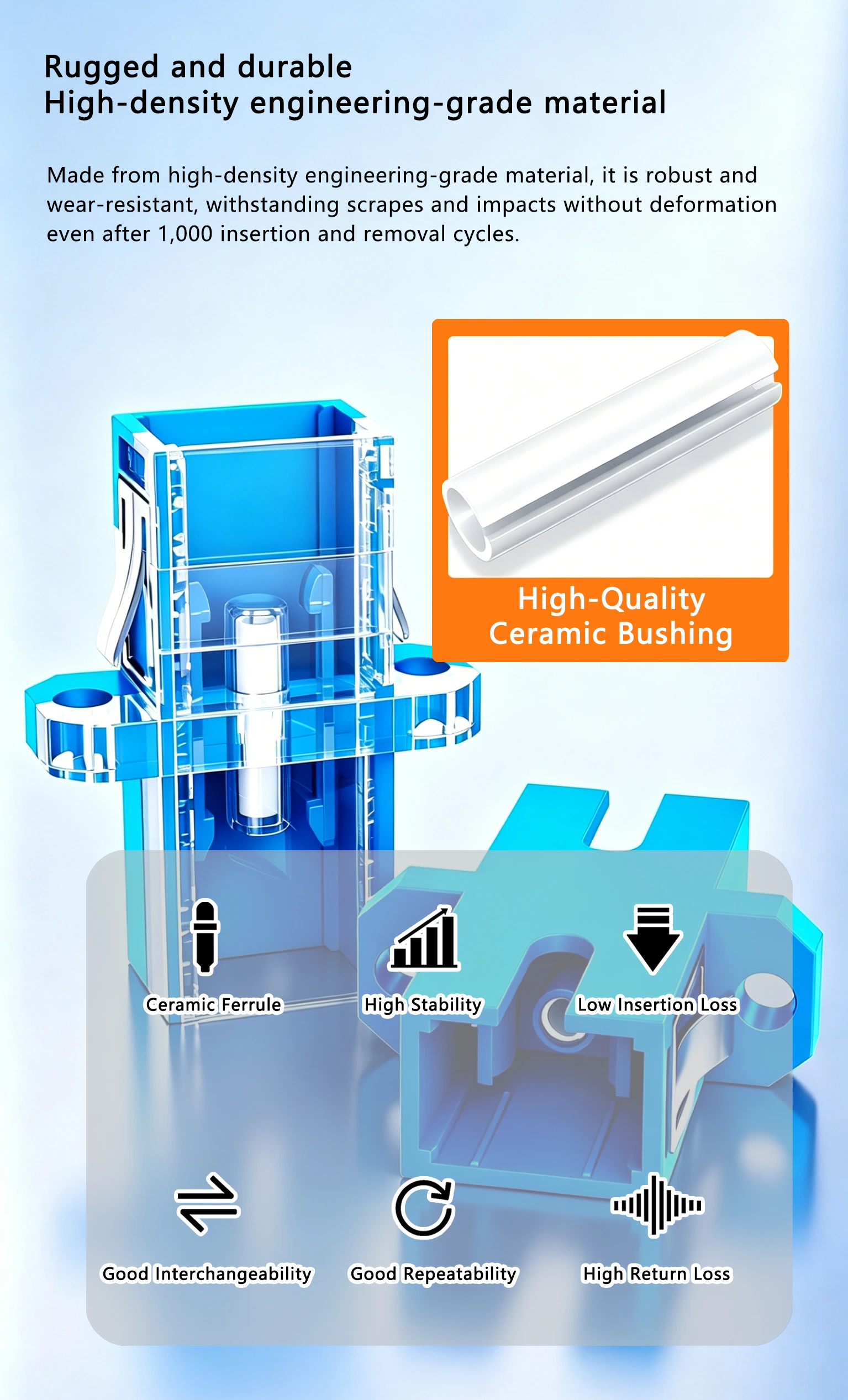
A fiber optic adapter—also known as a fiber optic flange or coupler—is a critical passive optical component used to align and connect two fiber optic connectors, whether of the same or different types. Its primary function is to ensure the precise alignment of fiber cores—facilitated by internal structures such as precision ceramic sleeves—thereby enabling optical signal transmission with low insertion loss and high return loss. Common interface types include FC, SC, LC, ST, and MPO; these can be further categorized based on end-face polish (e.g., PC, UPC, APC) and channel configuration (e.g., simplex, duplex). Widely used in fiber distribution frames, optical communication equipment, data centers, and Fiber-to-the-Home (FTTH) applications, it serves as a fundamental component in building high-speed, stable fiber optic networks.
Fiber Optic Adapter Advantage Specifications
Connector Type:SC-SC
Body Style:Simplex、Duplex
Polish Type:UPC
Fiber Mode:OS2 9/125μm
Insertion Loss:≤0.2dB
Durability:1000 times
Mounting Type:Full Flanged
Alignment Sleeve Material:Ceramic
Color:Blue
Operating Temperature:-40 to 75°C (-40 to 167°F)
Storage Temperature:-10 to 60℃(14 to 140℉)
Fiber Adapters Product Type
Fiber optic adapters provide mating interfaces corresponding to various types of fiber optic connectors.
Compatible connector types include LC, SC, FC, ST, MTRJ, E2000, etc.
Compatible connector end-face types include PC, UPC, APC, etc.
PC/UPC Type: Features a slightly spherical end-face; UPC polishing is finer, resulting in lower loss, and the color is typically blue.
APC Type: Features an end-face cut at an 8-degree angle, minimizing reflection; suitable for long-distance transmission, and the color is typically green.
LC stands for Lucent Connector. It is compact—resembling a scaled-down version of the SC connector—making it ideal for high-density cabling and widely used in data centers. Dual-core and even quad-core LC adapters are also available, offering further space savings.
SC stands for Standard Connector. Features a large square port and a push-pull connection mechanism for ease of use; commonly found in LAN and FTTH (Fiber to the Home) applications.
FC stands for Fiber Connector. Features a round, threaded opening that screws tight for excellent stability; commonly used in testing equipment and legacy server rooms.
ST stands for Straight Tip. Bayonet-style, similar to old-fashioned BNC connectors; commonly used in Fiber-to-the-Home (FTTH) applications or testing.
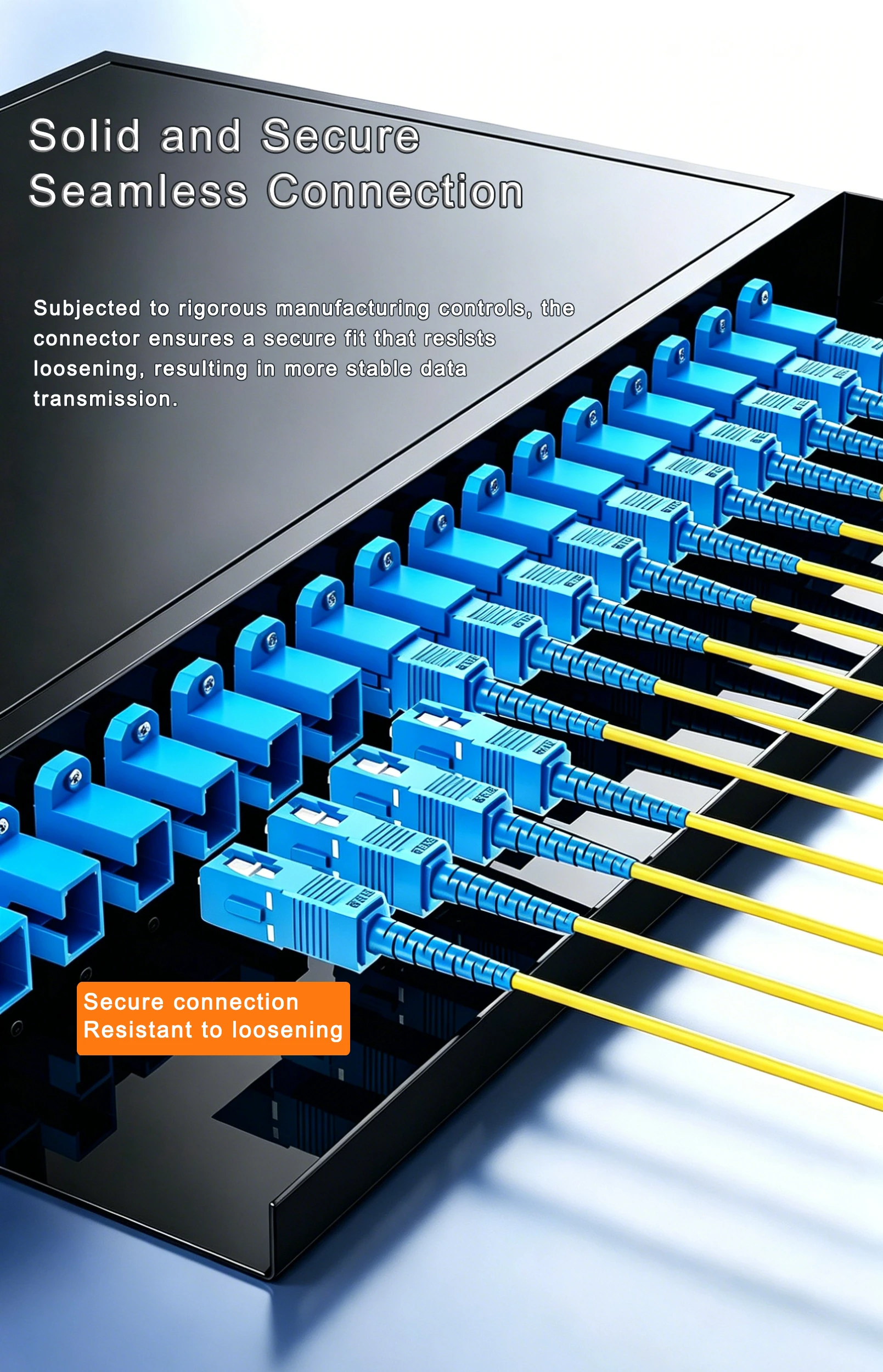
Fiber Adapter (Coupler) Features:
1、Ultra-low signal loss
2、High reflection suppression
3、Strong mechanical stability
4、Excellent environmental adaptability
5、Flexible scheduling and capacity expansion
6、Standardized compatibility and interoperability
7、High-density deployment capability
8、Significant cost-effectiveness
Fiber Optic Adapter Applications
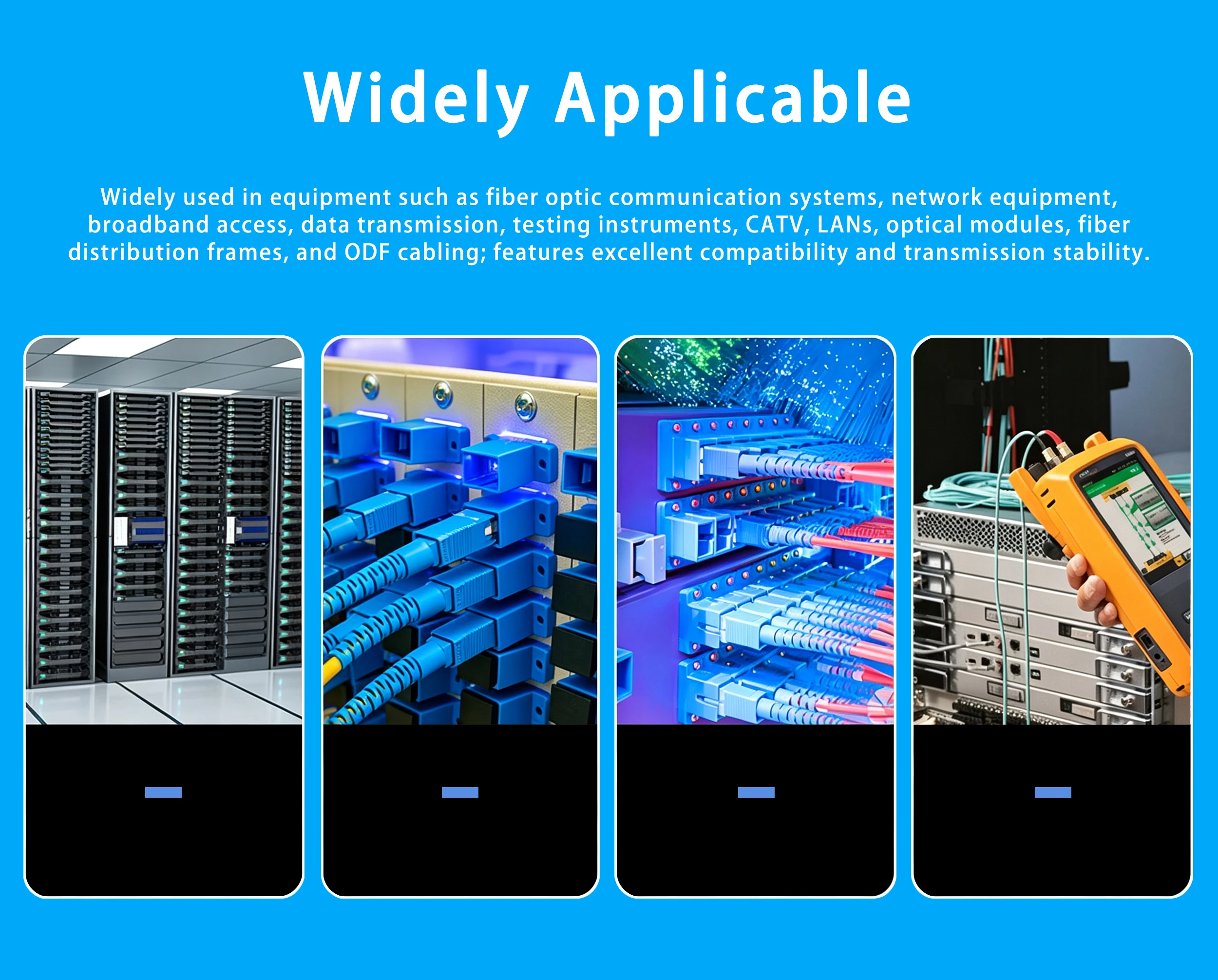
*Fiber optic adapters are widely used in fields such as fiber optic communication systems, cable television (CATV) networks, local area networks (LANs), metropolitan area networks (MANs), fiber-to-the-premises (FTTP), video transmission, and test instrumentation.
*As fundamental connection components, they are extensively utilized in optical distribution frames (ODFs), fiber optic communication equipment, instrumentation, and test and measurement systems.
*In high-density data centers, MPO/MTP adapters support connections for 40G/100G and even higher-speed optical modules, enhancing port density and cabling efficiency.
In 5G mobile communication fronthaul networks, they provide reliable fiber optic interconnect solutions—such as using MPO-12 connectors for simultaneous multi-fiber mating—to improve installation efficiency.
*In industrial automation—such as PROFINET systems—fiber optic connectors and adapters with high ingress protection ratings (e.g., IP67) are employed to achieve interference-resistant fiber optic bus connections.
*They provide high-density, high-reliability fiber optic interconnect support for emerging infrastructures like cloud computing, artificial intelligence (AI), and high-performance computing (HPC), meeting the demands for high-speed data transmission.
 No products in the cart.
Reviews
There are no reviews yet.