

MTP Fiber Patch Cable
MTP® jumpers enable smooth transitions to higher transmission rates in data centers when used together with our trunk cables. They are mainly applied for interconnection within a cabinet. MTP® cabling offers a budget-friendly alternative to time-intensive on-site terminations, designed for high-density fiber installations in facilities needing space efficiency and easier cable administration.
MTP®-24 is well-suited for 20-fiber multimode parallel optics, including 100G CFP SR10 and 100G CXP SR10 module links.
Please note: US Conec MTP® connectors fully adhere to MPO specifications, featuring unique patented designs, enhanced accuracy, proven dependability, and improved performance over standard MPO connectors.
MTP Fiber Patch Cable Advantage Specifications
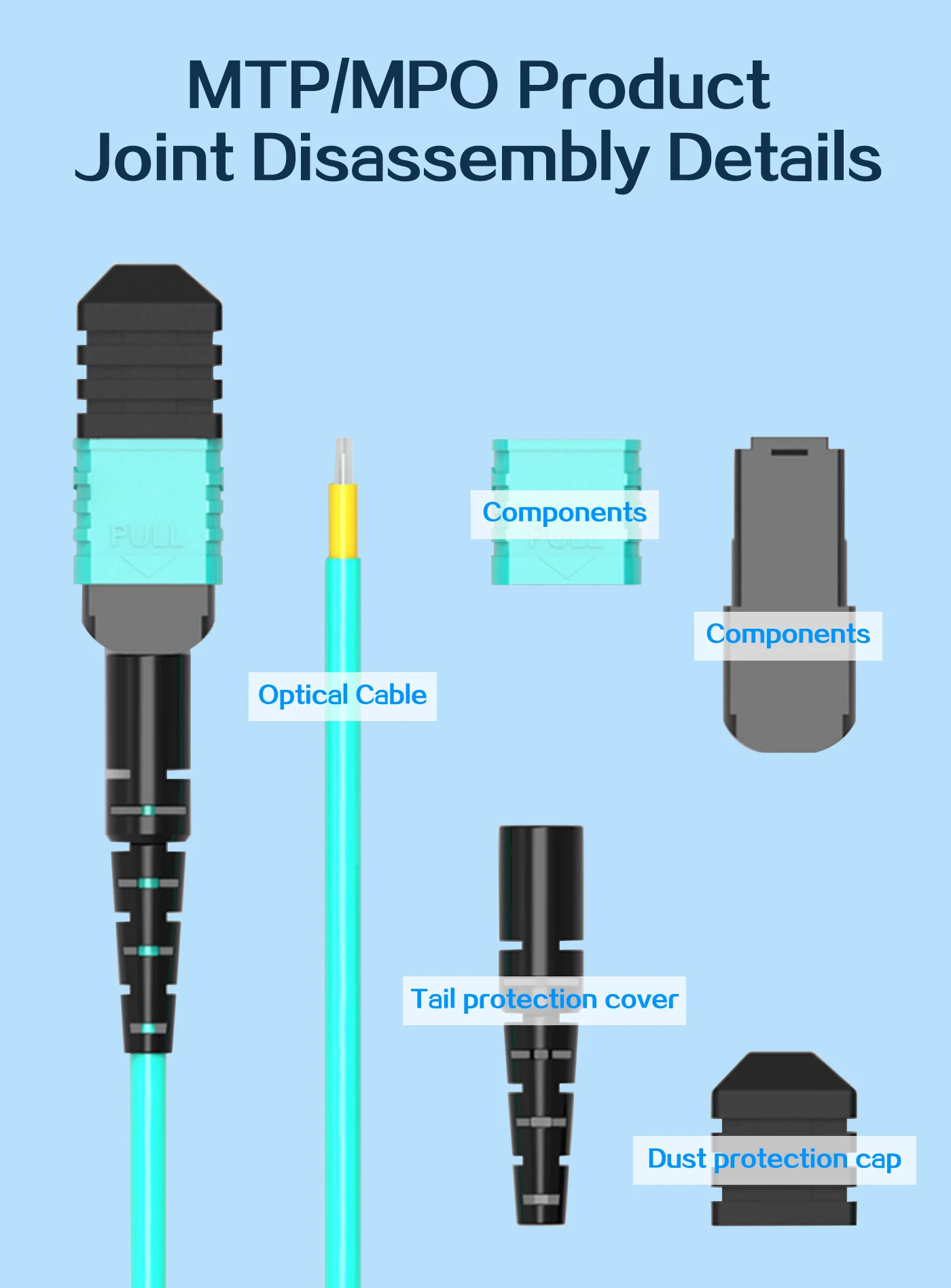
Connector A:US Conec MTP® Elite Male (with guide pins)
Connector B:US Conec MTP® Elite Male (with guide pins)
Polish Type:UPC to UPC
Fiber Mode:OM3 50/125μm
Wavelength:850/1300nm
Fiber Count:24 Fibers
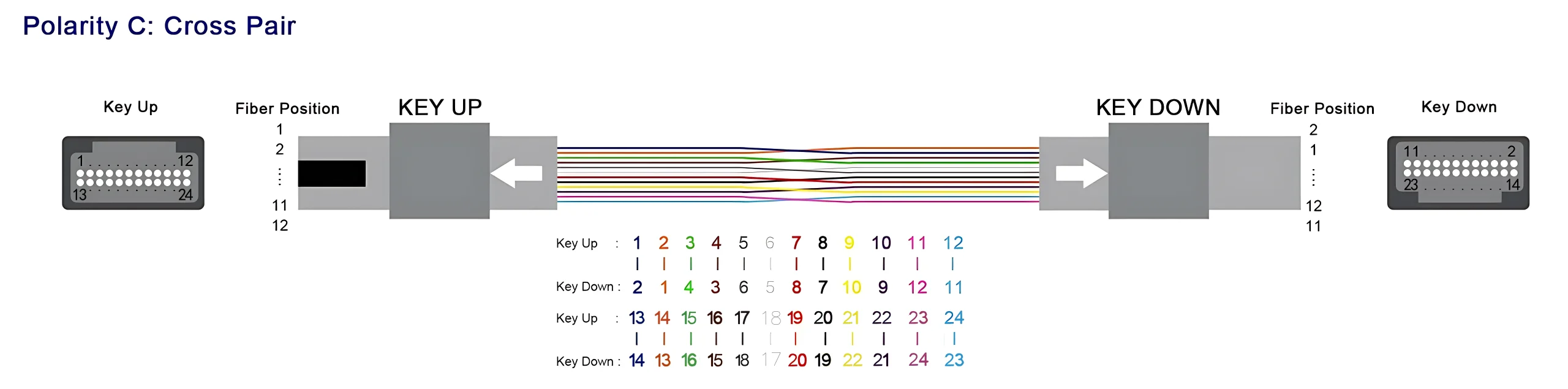
Polarity:Type C
Cable Outside Diameter (OD):3.0mm
Cable Jacket:Plenum (OFNP)
Min. Bend Radius (Optical Fiber):7.5mm
Min. Bend Radius (Fiber Cable):20/10D (Dynamic/Static)
Connector Durability:500 times
Tensile Strength:80/240N (Long/Short Term)
Insertion Loss:0.35dB Max
Return Loss:≥20dB
Attenuation at 850nm:≤2.3dB/km
Attenuation at 1300nm:≤0.6dB/km
Operating Temperature:-10 to 70°C (14 to 158℉)
Storage Temperature:-40 to 85°C (-40 to 185℉)
*MTP is a registered trademark of US Conec Ltd.
MTP Patch Cable Polarity
The MTP® 24-fiber Type C cable is a high-density fiber optic trunk designed for data center backbone applications, featuring a pairwise flip polarity. Unlike Type A (straight-through) or Type B (reverse), the Type C design swaps fibers in a pairwise manner across the 24 fibers. This ensures that each transmit (Tx) fiber at one end is properly aligned with its corresponding receive (Rx) fiber at the opposite end.
mtp 24 jumper Key Features:
Structure and Components
Connector type: MTP® 24-fiber connector with a single high-density ferrule
Fiber count: 24 fibers, arranged in 12 pairs
Polarity: Type C (pairwise crossover) – fiber 1 connects to fiber 2 at the far end, fiber 3 to 4, fiber 5 to 6, and so forth, across all 24 fibers
Cable jacket: Available in OFNR, OFNP, or LSZH, with standard color coding (aqua for OM3/OM4, yellow for OS2, etc.)
Application
Parallel optics systems: Ensures proper alignment of transmit/receive channels in 40G, 100G, 200G, and 400G Ethernet links
Backbone cabling: Used to connect MTP® cassettes, distribution panels, and trunk systems where pairwise polarity is required
Migration flexibility: Supports modular structured cabling systems for smooth upgrades from lower to higher data rates
Key Advantages
Correct polarity assurance: Prevents channel inversion by guaranteeing Tx fibers always map to Rx fibers
High density: Combines 24 fibers into a single connector, reducing cabling bulk
Efficient scalability: Designed to work seamlessly in environments that demand parallel transmission and fast reconfiguration
MTP Fiber Patch Cable Advantage
- 100% use low-loss connectors
- Each MPO patch cord is fully tested for insertion loss & return loss, 100% tested, and batch goods are not sloppy
- Each line guarantees 3D geometric dimensions and end face integrity, imported equipment measures 3D, and dust-free workshops ensure cleanliness
- Affordable price, quality assurance, source manufacturers take both quality and price into consideration
- All materials have passed REACH/ROHS environmental protection requirements and are of export quality
- Adequate inventory, complete materials, and efficient production
- Customization of special specification MPO patch cords, fast delivery
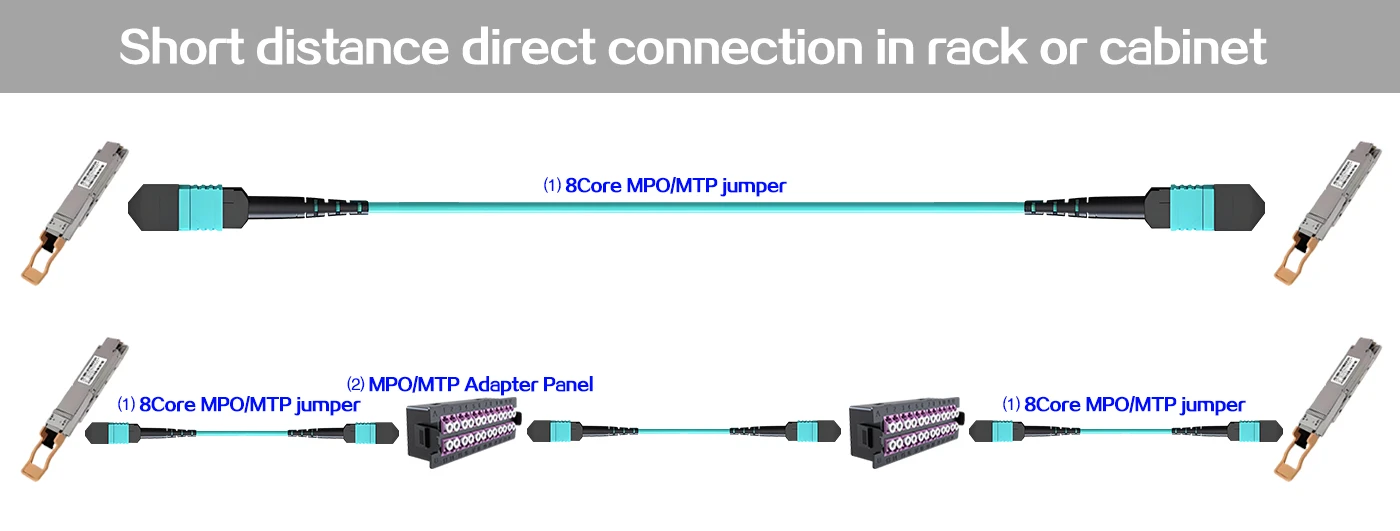
MTP Fiber Patch Cable Short distance direct connection in rack or cabinet
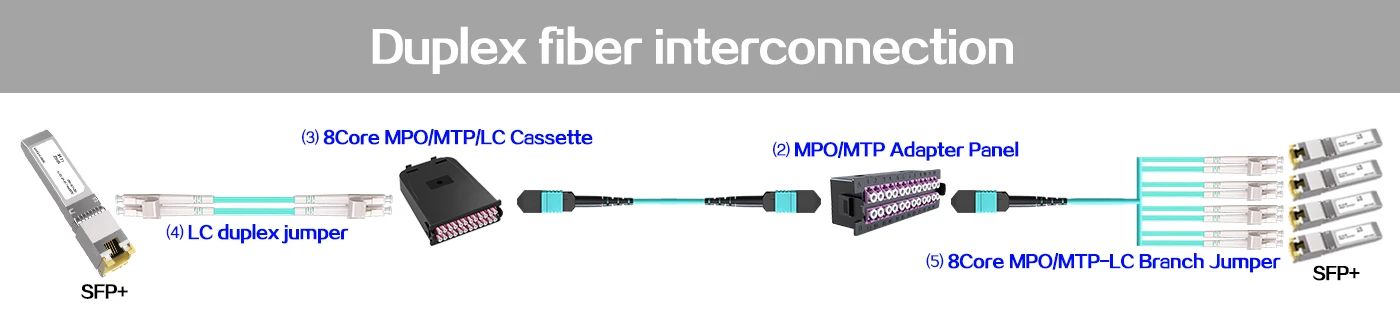
MTP Fiber Patch Cable Duplex fiber interconnection
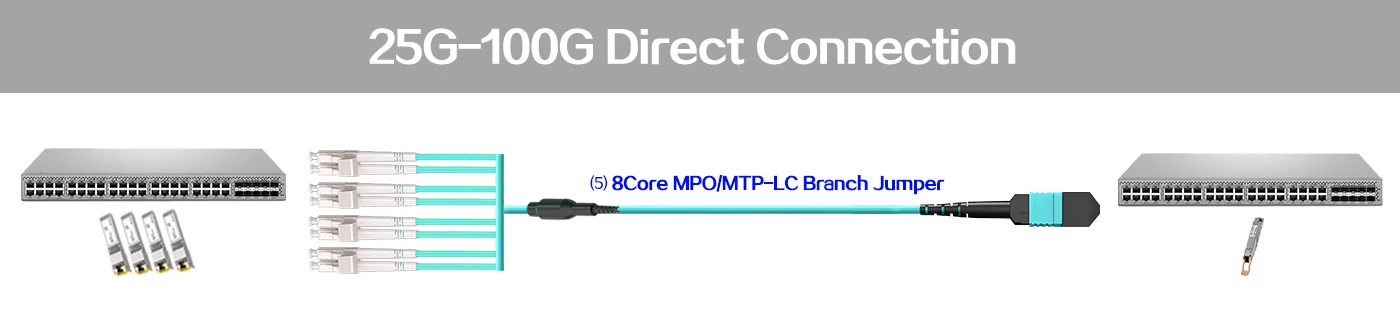
MTP Fiber Patch Cable 25G-100G direct connection
You can connect one 100G QSFP28 SR4 optical module to four 25G SFP28 SR optical modules through an 8-core MPO/MTP to four duplex LC multimode breakout cable. Similarly, you can connect one 100G QSFP28 PSM4 optical module to four 25G SFP28 LR optical modules through an 8-core MPO/MTP to four duplex LC multimode breakout cable.
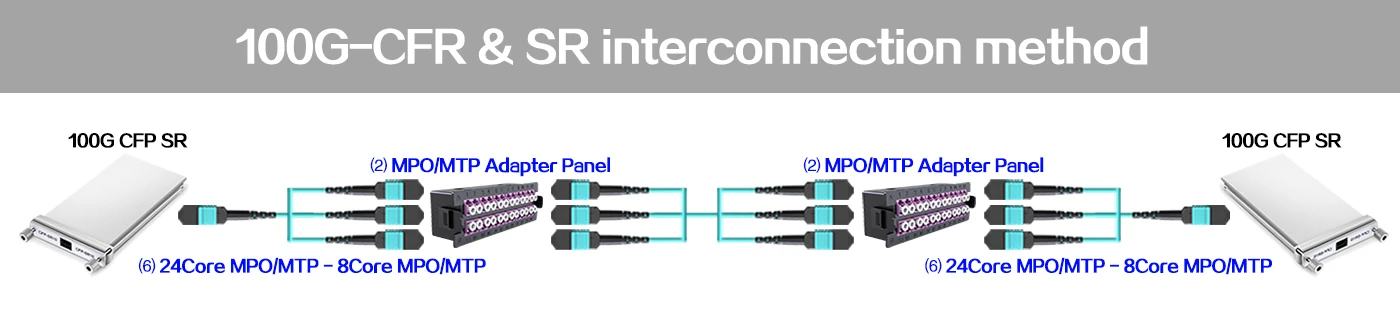
MTP Fiber Patch Cable 100G-CFR&SR interconnection method
The solution is to connect from one 100G CFP optical module to another CFP using a 24-core MPO/MTP to 3×8-core MPO/MTP breakout cable.
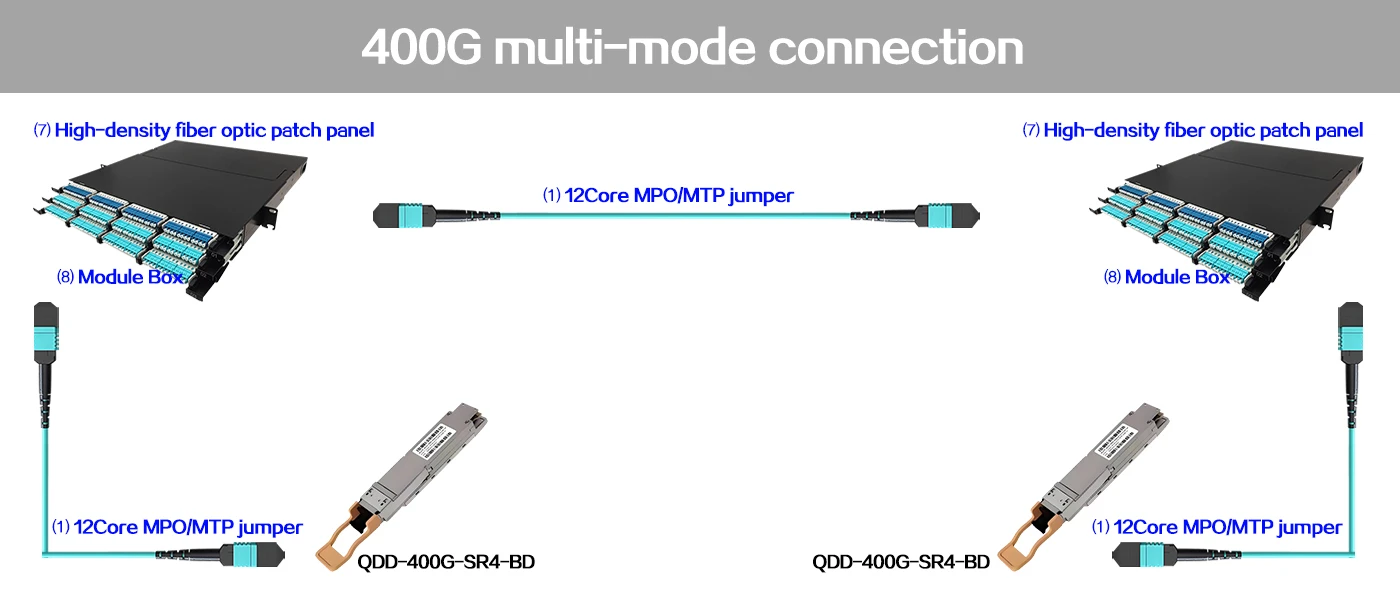
MTP Fiber Patch Cable 400G multi-mode connection
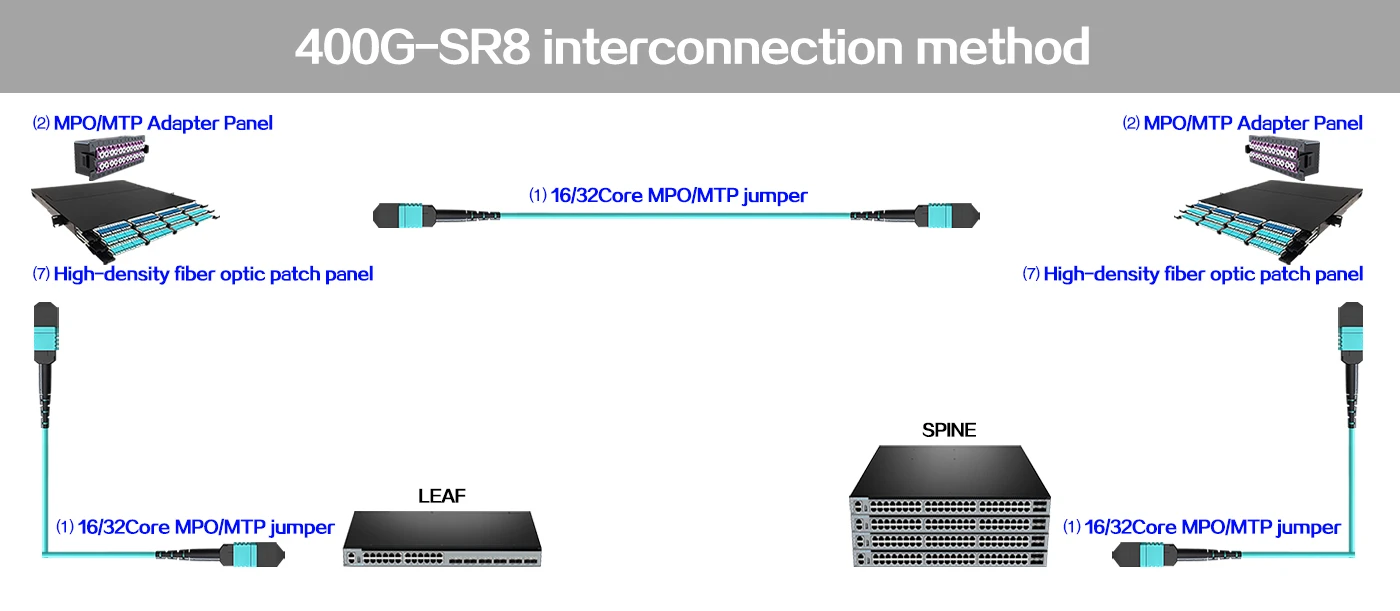
MTP Fiber Patch Cable 400G-SR8 interconnection method
The 400G QSFP-DD SR8 optical module uses a standard MPO-16 connector to achieve 400G transmission. The transmission distance through multimode optical fiber can reach up to 70m (OM3) or 100m (OM4).
MTP Fiber Patch Cable Application
High-speed interconnection in data centers
It is used for direct connection of 40G/100G optical modules, supports 400G high-speed transmission, and can improve wiring density and transmission efficiency. For example, 400G QSFP-DD DR4 optical modules can be directly connected through MPO/MTP-8 multimode fiber jumpers.
High-density wiring scenarios
In the backbone wiring of data centers, MTP/MPO trunk fiber jumpers are used in conjunction with adapter modules to achieve interconnection and cross-connection between devices, saving 45% of wiring space. Branch jumpers are used to connect devices with different rates (such as 10G and 40/100G devices).
100G/400G transmission expansion
Supports branch connection of 100G QSFP28 optical modules to 4 25G SFP28 optical modules, or interconnection of 100G CFP optical modules to another CFP.
Fiber-to-Building Applications
It is used for fiber-to-the-building (FTTB) wiring to meet the needs of high-density fiber access.

MTP Fiber Patch Cable Test Series
MTP Polarity Test Process
End face cleaning: Use special equipment to remove end face contaminants to avoid affecting the test accuracy.
Morphology detection: Analyze the end face microstructure through 3D imaging technology to detect surface roughness, scratches and other defects.
Insertion loss test: Measure the contact loss between the fiber end face and the connector ferrule to evaluate the signal transmission quality.
Polarity verification: Confirm the correspondence between the number of fiber cores and the connector guide hole to prevent communication failure caused by wrong connection.
MTP Test Key Indicators
Cleaning efficiency: It must reach more than 98% to ensure that there are no residual stains on the end face.
Detection accuracy: The resolution of 3D morphology detection must be less than 1.5μ, and the insertion loss error must be controlled within 0.3dB.
Test time: It takes about 10 seconds to detect a single fiber core of a 12-core MPO jumper, and the overall test takes about 2 minutes.
MTP jumper cable Test Common Problems
Pollution sensitivity: Tiny particles on the end face will cause increased loss, and non-contact cleaning methods are required to protect the end face.


 No products in the cart.
Reviews
There are no reviews yet.