

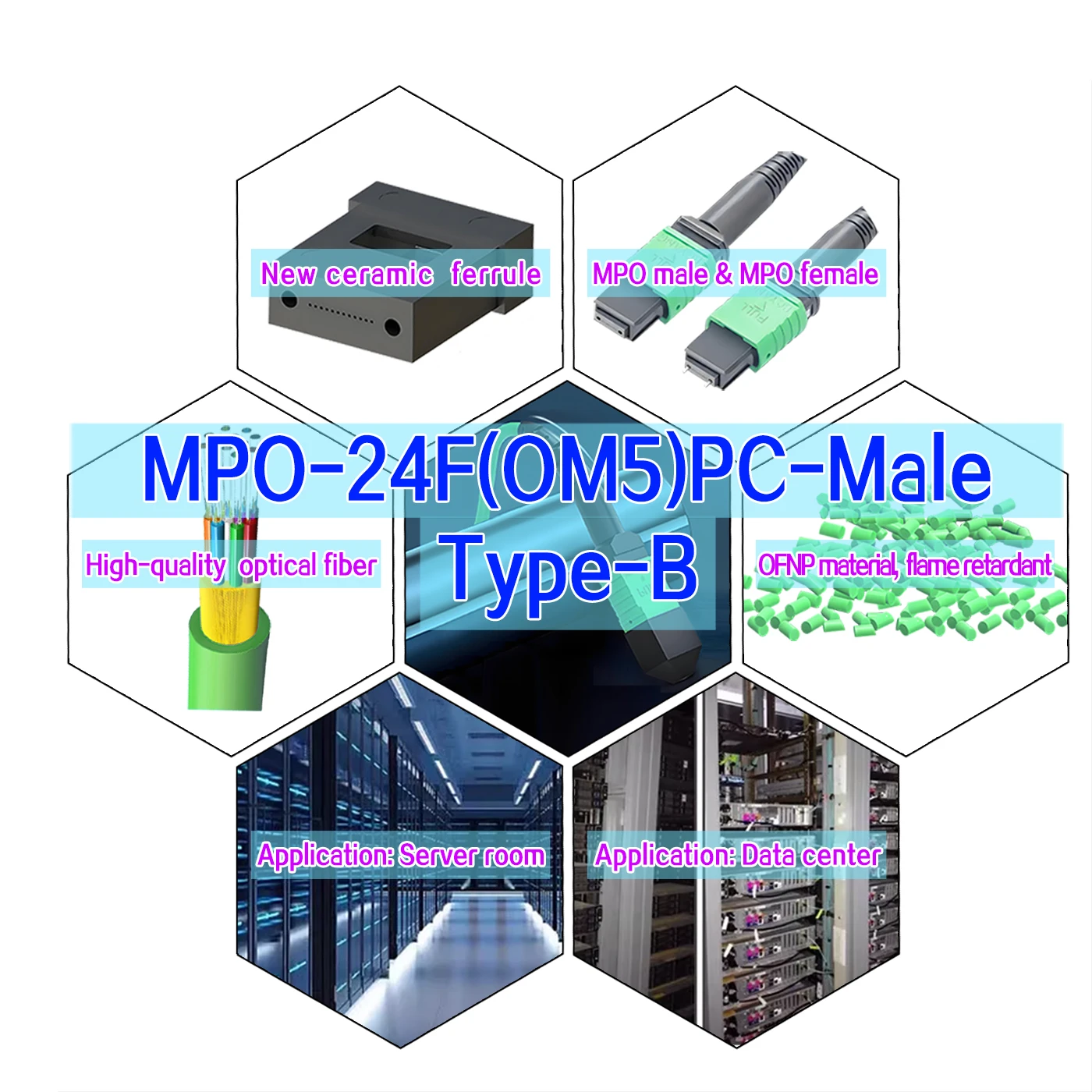
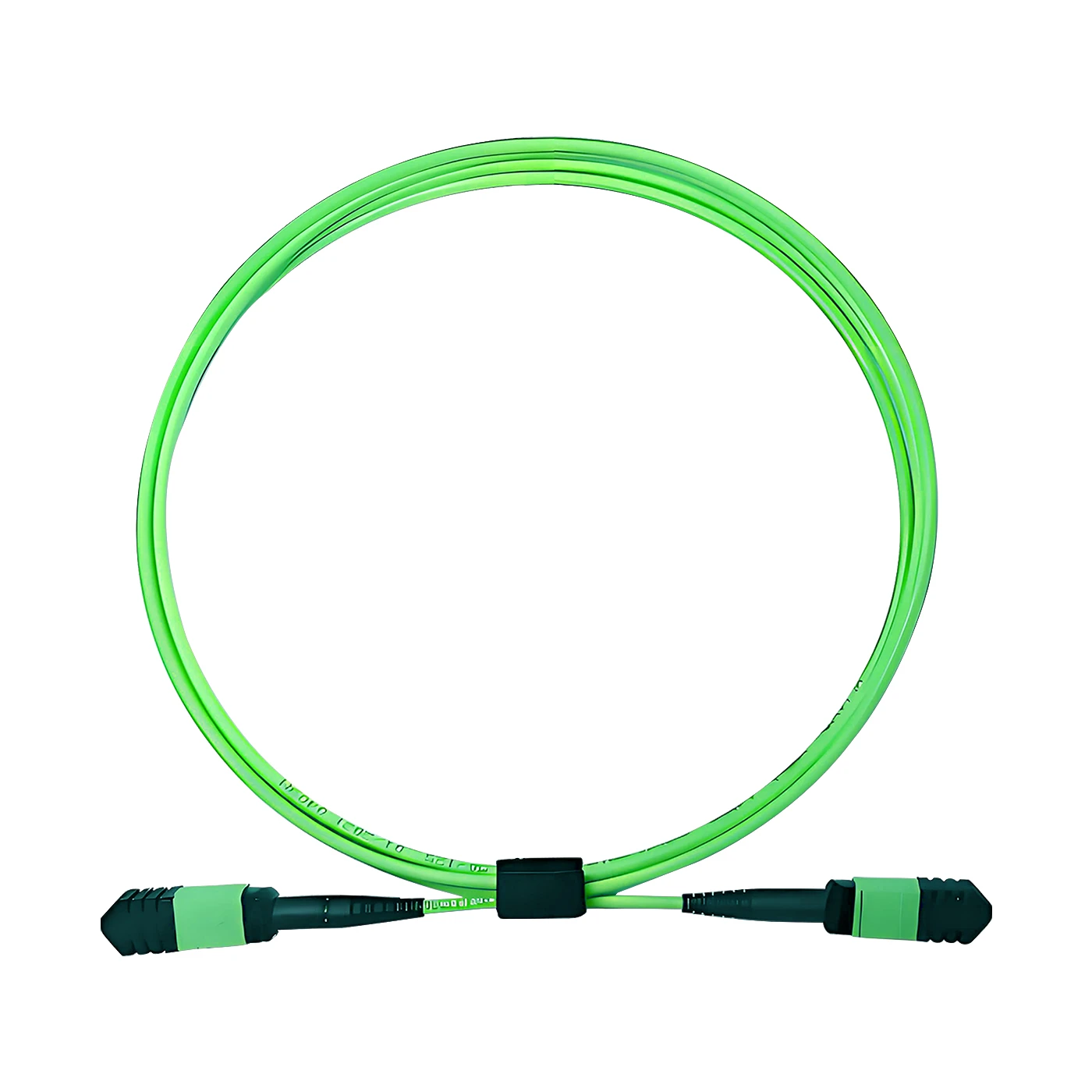
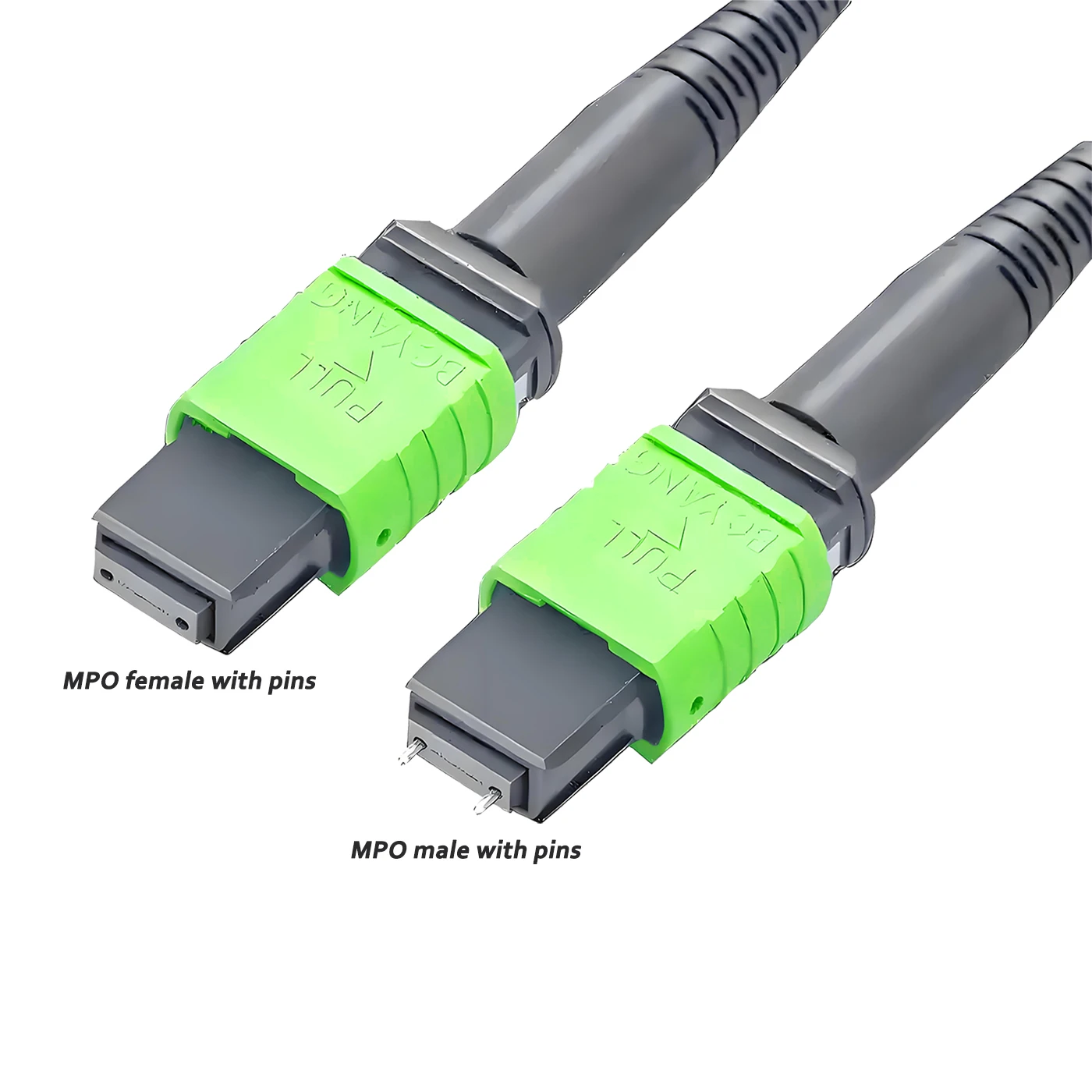
24 Core MPO Cable
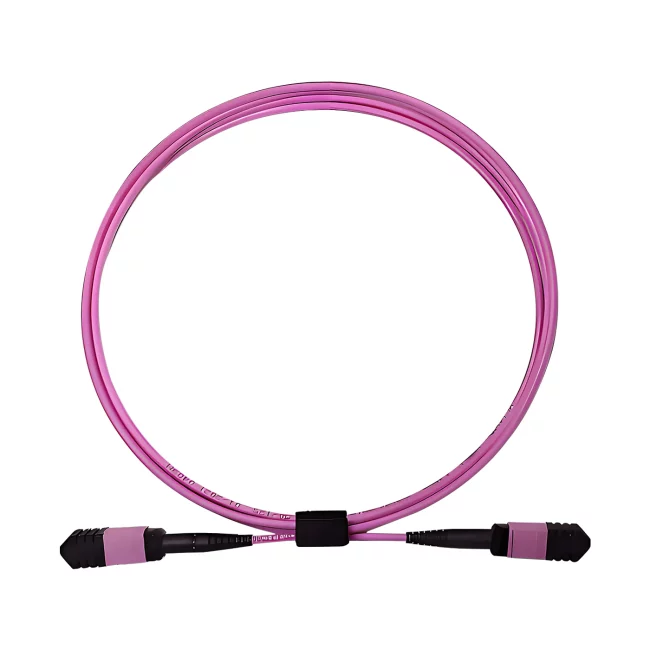
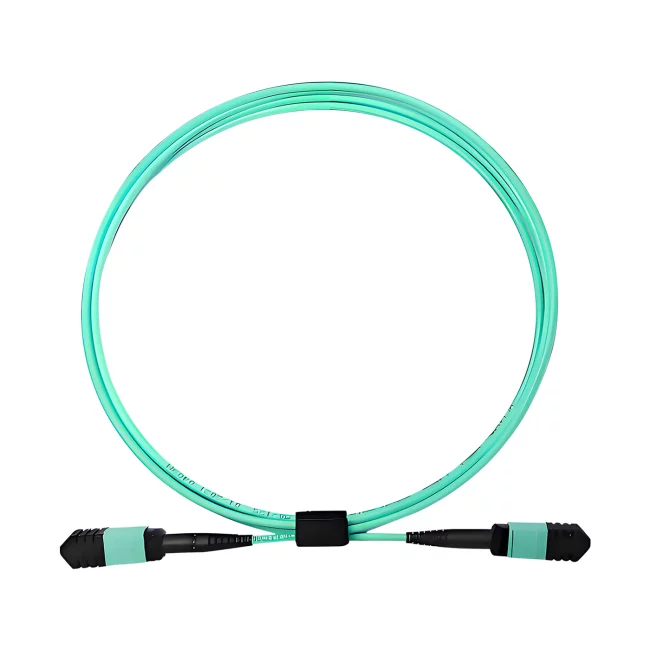
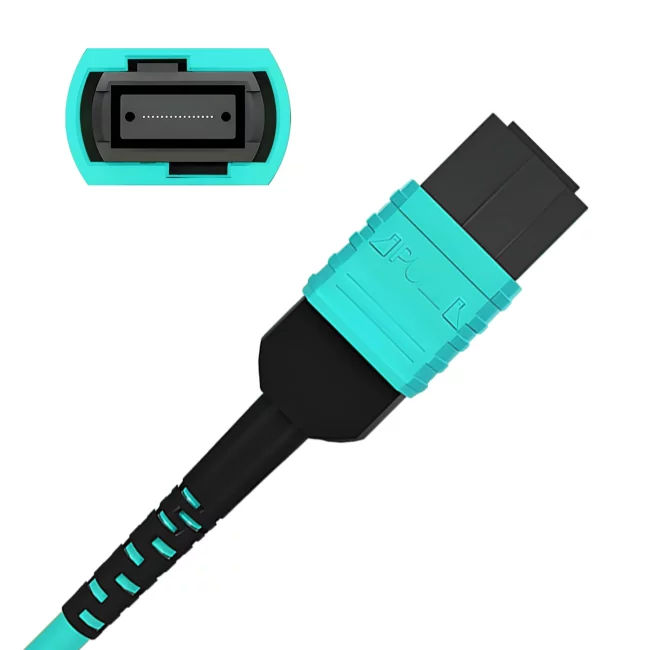
The MPO jumper cable is an affordable substitute for traditional on-site fiber termination methods that require more time and labor. It is specifically designed for high-density network cabling in data centers, helping optimize space and simplify cable arrangement. Moreover, the bend-insensitive fiber structure ensures dependable signal transmission and high connection quality, even in restricted routing spaces or tight bend scenarios.
The MPO 24-fiber Type B male connector provides a reliable and efficient connectivity solution for modern optical networks, offering accurate polarity management, excellent optical performance, and support for next-generation high-speed data center applications.
MPO Cable 24 Advantage Specifications
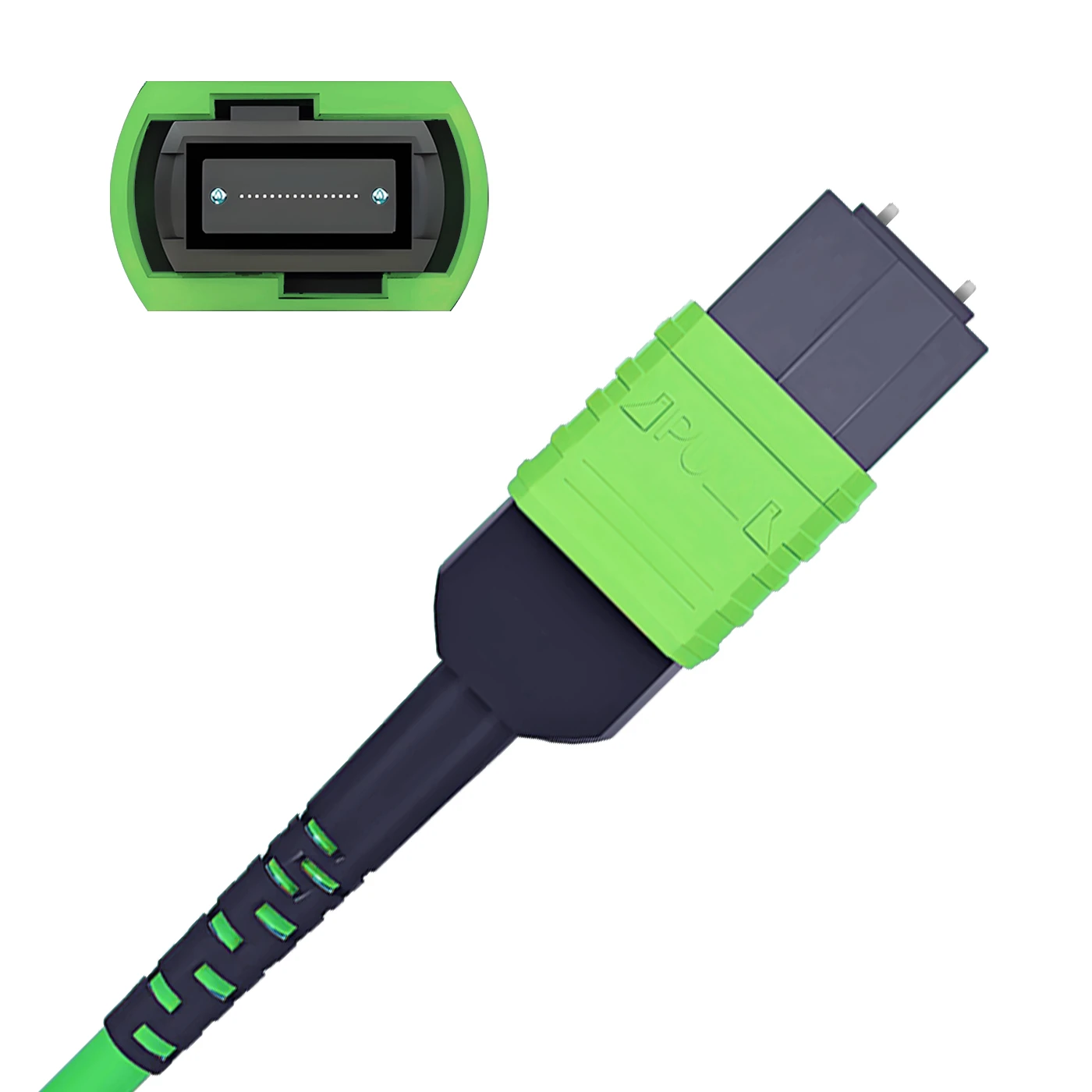
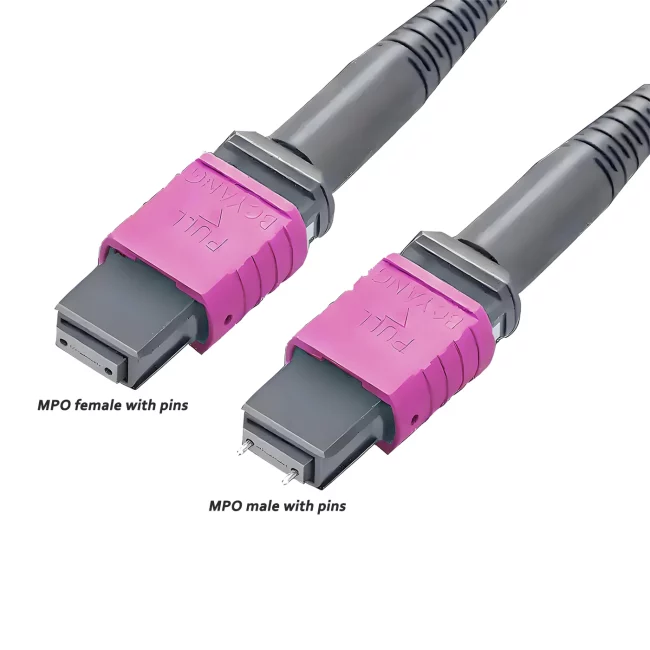
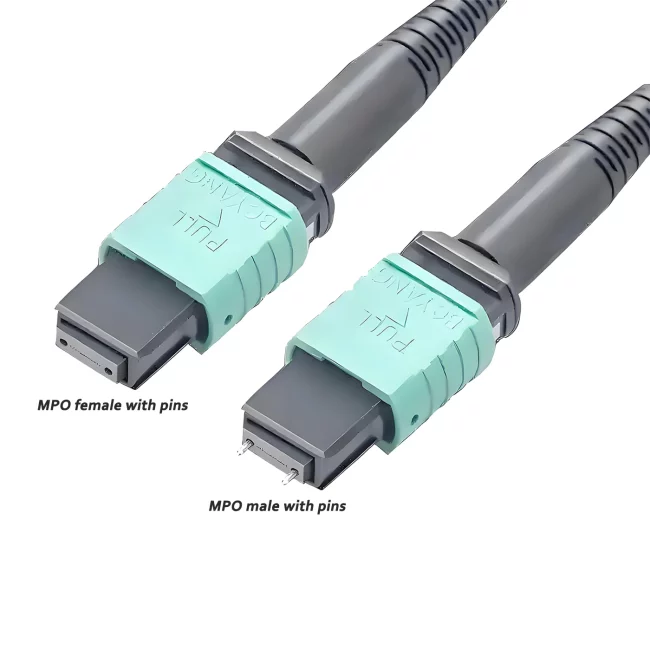
Connector A:MPO Male (with guide pins)
Connector B:MPO Male (with guide pins)
Polish Type:PC to PC
Fiber Mode:OM5 50/125μm
Wavelength:850/1300nm
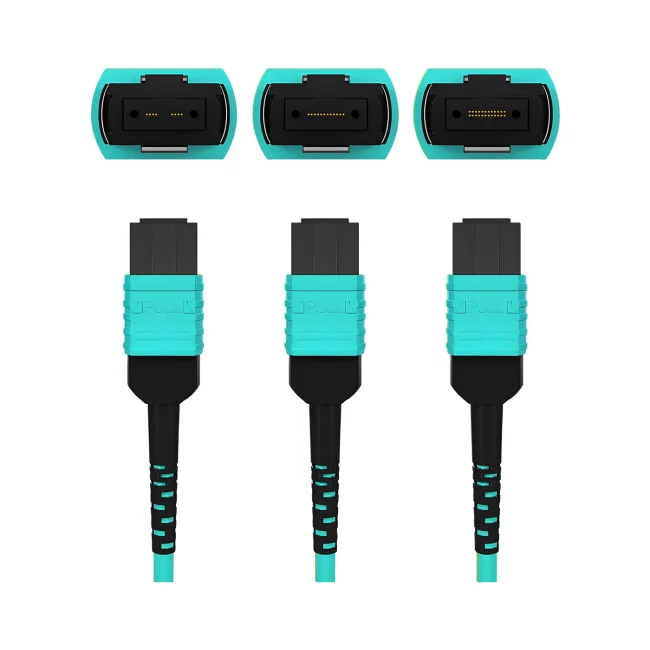
Fiber Count:24 Fibers
Polarity:Type B
Cable Outside Diameter (OD):3.0mm
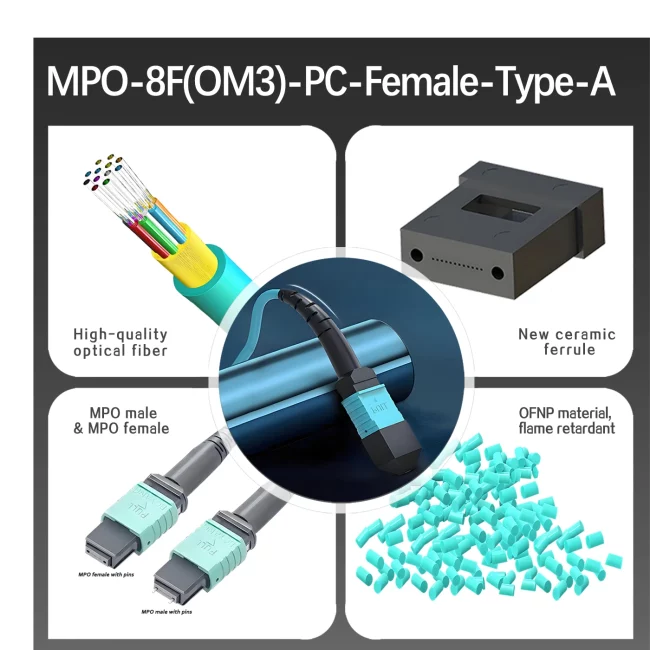
Cable Jacket:Plenum (OFNP)
Min. Bend Radius (Optical Fiber):10mm
Min. Bend Radius (Fiber Cable):10/5D (Dynamic/Static)
Connector Durability:500 times
Tensile Strength:80/240N (Long/Short Term)
Insertion Loss:0.35dB Max
Return Loss:≥25dB
Operating Temperature:-10 to 60°C (14 to 140℉)
Storage Temperature:-10 to 70°C (14 to 158℉)
24 Fiber MPO Polarity
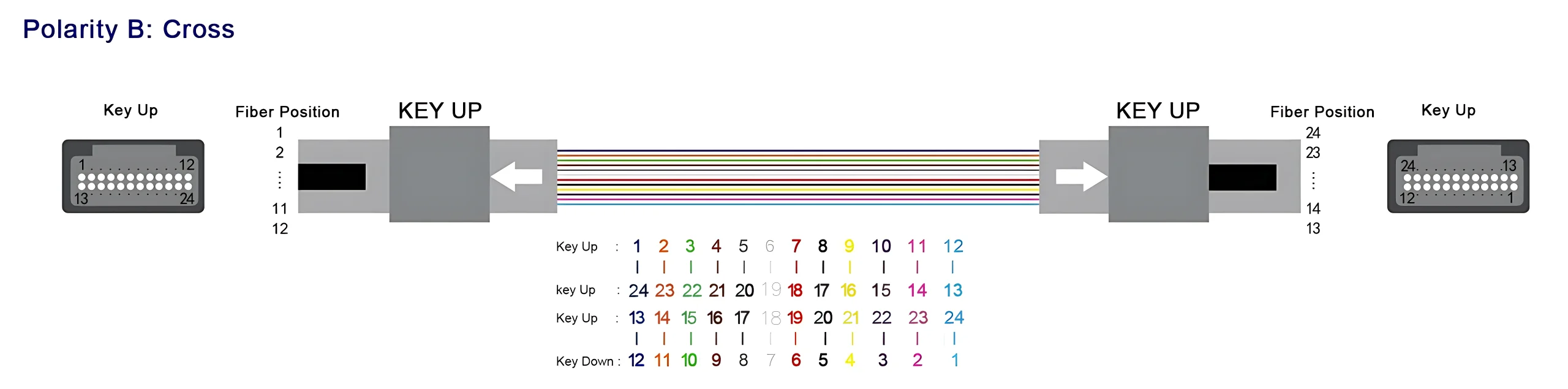
The MPO 24-fiber Type B male connector is a high-density fiber optic connector designed for high-speed data center networks and parallel optical transmission applications. It follows the Type B polarity method, which uses a reversed fiber mapping configuration. This polarity arrangement ensures proper transmit (Tx) and receive (Rx) channel alignment between interconnected devices.
In a Type B configuration, the fiber positions are mirrored from one end of the connector to the other For example:
- Fiber 1 → Fiber 24
- Fiber 2 → Fiber 23
- Fiber 3 → Fiber 22
- Fiber 4 → Fiber 21
- ……..
- Fiber 21 → Fiber 4
- Fiber 22 → Fiber 3
- Fiber 23 → Fiber 2
- Fiber 24 → Fiber 1
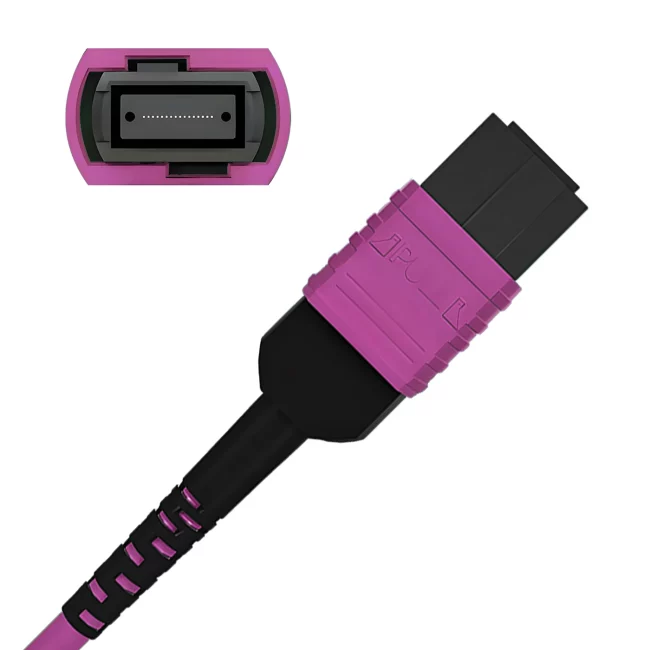
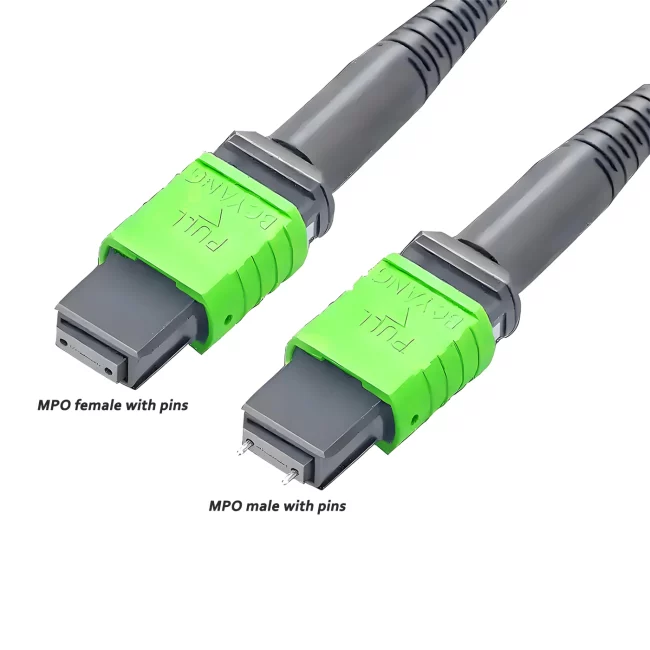
As a male connector, it features two guide pins on the MT ferrule, ensuring precise alignment when connected to a female MPO connector. This design helps maintain low insertion loss and reliable optical performance.
MPO 24 Polarity:
- Connector Type: MPO 24-fiber male (with guide pins)
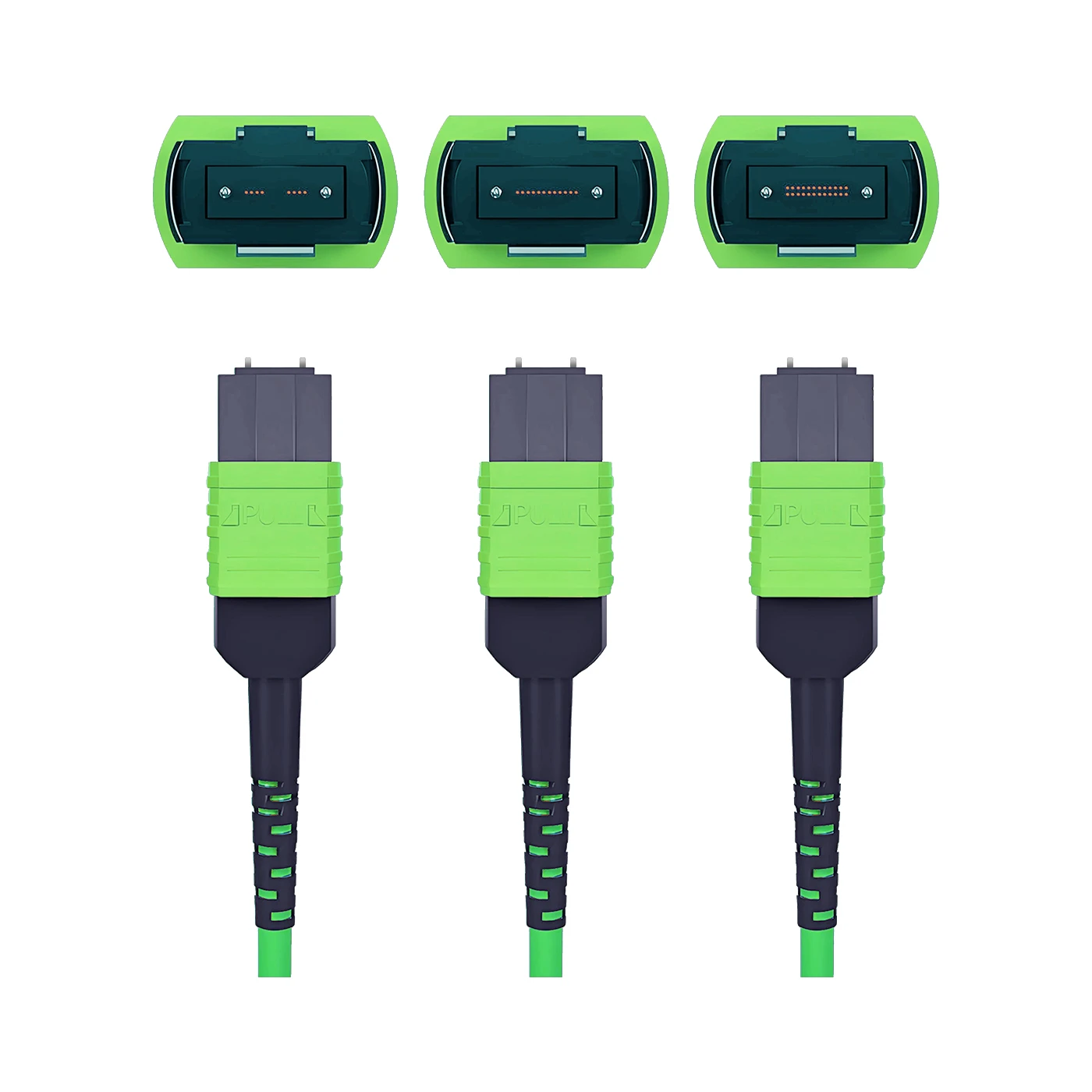
- Fiber Count: 24 fibers in a high-density MT ferrule
- Polarity: Type B (reversed fiber mapping)
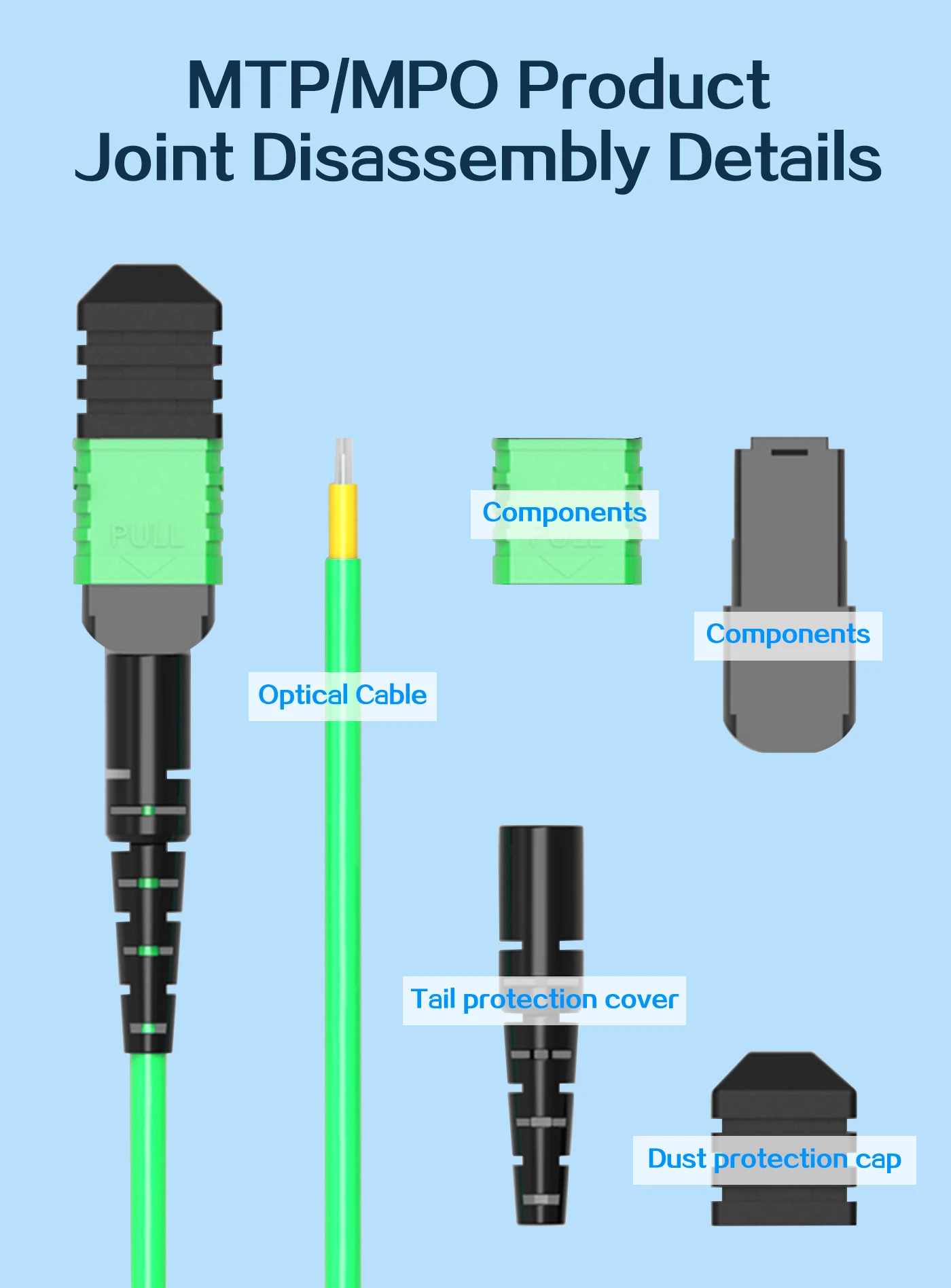
- Ferrule Design: Precision MT ferrule for accurate fiber alignment
- Fiber Compatibility: Supports OS2 single-mode and OM3/OM4/OM5 multimode fibers
- Cable Jacket Options: Available in LSZH, OFNR, and OFNP ratings
MPO Patch Cable Applications
- 100G, 200G, 400G, and 800G Ethernet networks
- High-density data center backbone cabling
- Parallel optical transceiver interconnections
- MPO trunk cable and patch panel systems
- Cloud computing, AI, and hyperscale data center infrastructures
MPO Jumper Cable Advantage
- Reversed polarity design ensures correct Tx/Rx signal routing
- Ultra-high-density connectivity supports 24 fibers in a compact footprint
- Reliable mating performance through precision guide-pin alignment
- Efficient cable management in high-density environments
- Scalable architecture for future bandwidth expansion
- 100% use low-loss connectors
- Each MPO patch cord is fully tested for insertion loss & return loss, 100% tested, and batch goods are not sloppy
- Each line guarantees 3D geometric dimensions and end face integrity, imported equipment measures 3D, and dust-free workshops ensure cleanliness
- Affordable price, quality assurance, source manufacturers take both quality and price into consideration
- All materials have passed REACH/ROHS environmental protection requirements and are of export quality
- Adequate inventory, complete materials, and efficient production
- Customization of special specification MPO patch cords, fast delivery
MPO Multimode Cable SPIN-LEAF connection method
MPO Multi Mode Cable Application
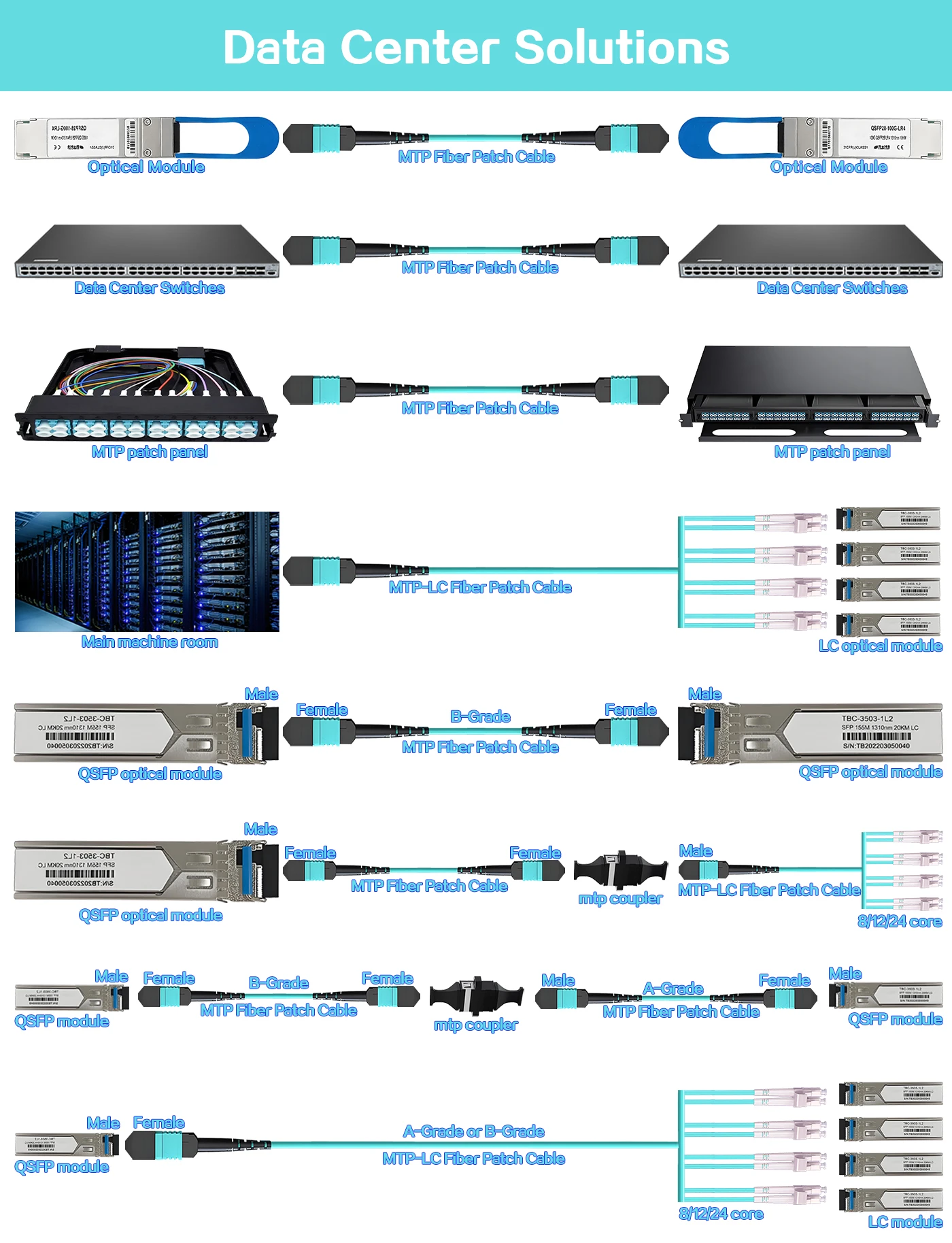
High-speed interconnection in data centers
It is used for direct connection of 40G/100G optical modules, supports 400G high-speed transmission, and can improve wiring density and transmission efficiency. For example, 400G QSFP-DD DR4 optical modules can be directly connected through MPO/MTP-8 multimode fiber jumpers.
High-density wiring scenarios
In the backbone wiring of data centers, MTP/MPO trunk fiber jumpers are used in conjunction with adapter modules to achieve interconnection and cross-connection between devices, saving 45% of wiring space. Branch jumpers are used to connect devices with different rates (such as 10G and 40/100G devices).
100G/400G transmission expansion
Supports branch connection of 100G QSFP28 optical modules to 4 25G SFP28 optical modules, or interconnection of 100G CFP optical modules to another CFP.
Fiber-to-Building Applications
It is used for fiber-to-the-building (FTTB) wiring to meet the needs of high-density fiber access.

MPO Multi Fiber Push On Test Series
Is MPO Multimode Polarity Test Process
End face cleaning: Use special equipment to remove end face contaminants to avoid affecting the test accuracy.
Morphology detection: Analyze the end face microstructure through 3D imaging technology to detect surface roughness, scratches and other defects.
Insertion loss test: Measure the contact loss between the fiber end face and the connector ferrule to evaluate the signal transmission quality.
Polarity verification: Confirm the correspondence between the number of fiber cores and the connector guide hole to prevent communication failure caused by wrong connection.
MPO Multimode Fiber Cable Test Key Indicators
Cleaning efficiency: It must reach more than 98% to ensure that there are no residual stains on the end face.
Detection accuracy: The resolution of 3D morphology detection must be less than 1.5μ, and the insertion loss error must be controlled within 0.3dB.
Test time: It takes about 10 seconds to detect a single fiber core of a 12-core MPO jumper, and the overall test takes about 2 minutes.
Cable OM5 mpo Test Common Problems
Pollution sensitivity: Tiny particles on the end face will cause increased loss, and non-contact cleaning methods are required to protect the end face.

 No products in the cart.
Reviews
There are no reviews yet.